Monday, March 24, 2014

Felice Nel Box + Save the Synagogue! Project

Recently I was contacted by Ghila Valabrega, writer, director and producer of Felice Nel Box, what it seems to be a very interesting comedy with a Jewish cemetery as the starting point. This movie shows the unfortunately condition of many of Jewish cemeteries across Europe and I hope it will be a wake up call for many people that can help restore and save this and many other pieces of the history like the Synagogue of Sabbioneta.
Bellow is more information about the movie and how you can help this project become a reality.


About the Movie
Ghila Valabrega’s first work, Felice Nel Box, tells, with yiddish humor, two stories in one movie: an intimate and surreal family tale based on true events and a broader narration of the Jewish community in Sabbioneta, Italy.


The plot
Back in the ‘70s, my dad, Stefano, was a curious photographer with a cool motorbike. One day, he found himself carrying out an assignment around Mantova, northern Italy. On his way home, he spotted by chance the old ruins of an abandoned Jewish cemetery.


Touched by the terrible state of the place, he impulsively decided to take one of the tombstones back with him to Milan. My dad did not know that, by doing so he had awaked the ghost of Felice Leon Foà, an 1800 Jewish man, who, following his tombstone, jumped on my dad’s motorbike.

The tombstone ended up staying for over thirty years, forgotten, in our car box and so did Felice... until my sister, my mom and I discovered them...

To donate and help this project visit http://www.indiegogo.com/projects/help-felice-restore-the-ancient-synagogue-of-sabbioneta/x/5239956

Thursday, May 31, 2012

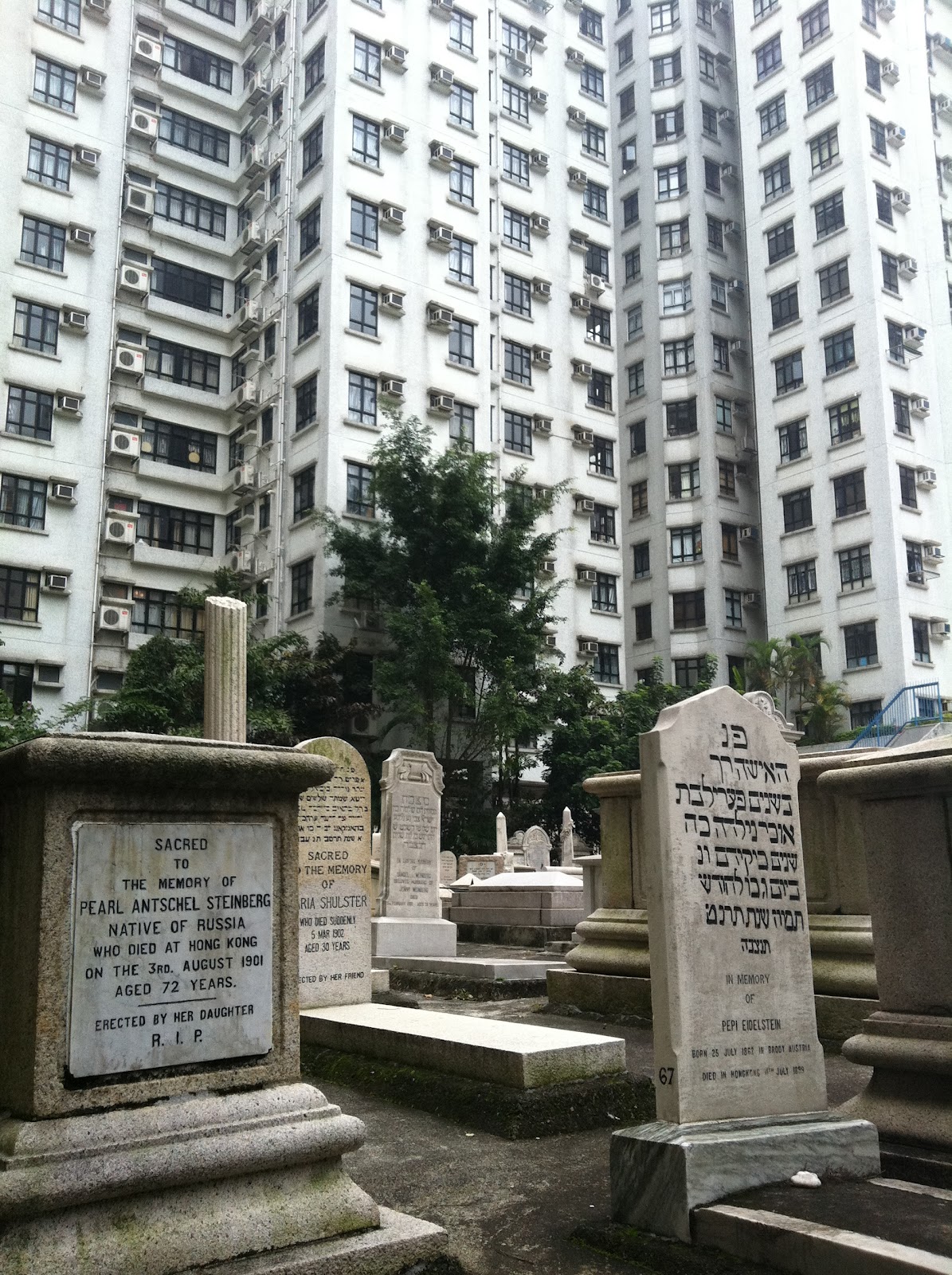
Happy Valley: Jewish cemetery in Hong Kong

I have what some people consider a weird custom of visiting Jewish cemeteries wherever I go.

It’s not that I have a relative buried there, although it may be so -you never know- it’s simply that I’m a genealogist, and this is similar to checking phone books to see how many with the Horowitz live in a town.  

Cemetery Main Entrance
In March, I was on my way to the Australasian Congress in Adelaide, Australia and stopped over in Hong Kong. In addition to the great time I had -and the wonderful people I met- I had an opportunity to meet with Howard Elias and Erica Lions, two members of the Jewish Historical Society and the people in charge of the Hong Kong Jewish cemetery.

I had never thought about a Jewish cemetery in Hong Kong - it is not documented in the JewishGen.org Jewish Online World Burial Register (JOWBR). Those who manage the cemetery are dedicated to resolving this quickly. All the gravestones have already been photographed and transcribed and will soon be available (and searchable) on the Internet.

The cemetery itself is amazing. When Howard and I arrived in a taxi, I saw only huge apartment buildings and some old-style Chinese buildings (a school and a temple). Imagine my surprise when he said, “Here they are, already waiting for me,” referring to a meeting with people doing restoration and maintenance work on the grounds.

This cemetery was once outside the city, as in many big cities around the world. The land is owned by the Jewish community, which wasn’t common in Hong Kong. Once a swamp, it was given to the community by the Queen of England with the hope that people would move to the neighborhood. The area's name is Happy Valley, meant to persuade people to move there, but as this idea never prospered, they decided to use it for the cemetery.

From the street, visitors wouldn’t guess that a cemetery was hidden behind the gate and those tall buildings (see photo). Visitors can see all the gravestones, many of which are Sephardic-style, raised above the ground. The oldest one I saw was from 1875, inscribed in Hebrew. Some were so old that the inscriptions were illegible.

Name and dates tell the story of Jewish immigration to Hong Kong and such difficulties as plague and other illnesses. Although these days the committee doesn’t have more than a few burials a year, the total number of graves is about 300. Some have Hebrew inscriptions, while some recall relatives from around the world. One carries an image of the deceased, not often seen in Jewish cemeteries, although it is common among the Russian and Persian Jewish Diasporas.

Perhaps most amazing was the view of the beautiful grounds from the surrounding apartments. In Chinese culture, cemeteries are sacred and respected areas. Obviously, the living neighbors don’t mind living adjacent to the dead. After all, they may be the best neighbors: they are quiet, don’t hold loud parties and never complain.


If you travel to Hong Kong, put Happy Valley on your must-see list.

Thursday, April 28, 2011

Take your smart phone to the cemetery!

I was on Long Island in New York the other day, preparing to give a lecture, when I realized that my aunt Rika Singer was buried only a few miles from where I was to speak.

I decided to go a little early and pay my respects.

Thanks to GPS, I arrived at the cemetery with no problems. Soon I found the section, block and area.

But as I began counting rows and tombstones, I realized I had problems. According to the cemetery website, my aunt was buried in row O.

Was that a zero or the letter O?

It’s easy to have a row zero in some cemeteries - they may have had to add a row before the original first one to make space - but she wasn't there. Did I count the rows in the wrong direction? She wasn't there. Then I tried to number the rows by letters, so I started A, B, C, D ... That didn't work either.

By now, I was getting worried and decided to review my data. Out came my new iPhone, found a Wi-Fi connection and went online to check my family tree data. Yes, the information was correct. I checked the cemetery website again - the information was the same - but my aunt wasn't there!

Could I do a reverse look up on the cemetery database? It seemed easy. There was the name of the person in front of me, and the database should give me his location. I did that a few times but all the names had numbered rows. If my aunt was in Row Zero, I was in trouble.

Amazingly, the phone also can be used for its original purpose - to make calls! I rang the administration office and spoke to a very kind lady who confirmed that I should be looking for the letter O and not zero. She explained that the area is divided in two - one with lettered rows and the other with numbers. With that information, I moved over to the left section and walked a few rows to the front and found Aunt Rika in the same spot she had been in for nine years.


I then turned on the camera feature to take pictures of the tombstone, and turned to Google maps to get the exact coordinates of the place where I was standing at the moment with the "Show my location" feature (image on the left is just an example as Long Island is in New York, not Oregon!). After all, I didn’t want any other relatives to walk around for hours as I did to find our beloved aunt.

I finally sent the tombstone image via email to my cousin - on the other side of the world - to show him my findings.

What did we do a few years ago when we didn't have Smart Mobile Devices with Internet, GPS, cameras and phones?

Sunday, April 18, 2010

Cemetery Project Q&A: Markers at babies' gravesites

The Jewish Graveyard Rabbit
welcomes contributor
Steve Lasky,
creator of the
online cybermuseum,
Museum of Family History.


Recently, someone wrote me with a question about baby markers, and how to keep the gravestone from completely sinking into the ground over time.

The question was:

"I recently had a baby marker created but the monument dealer/installer never heard of adding cement around the bottom of the stone and doesn't see how it prevents the stone from sinking. My question to you is: Do you know where I can obtain proof to show to the dealer? "

I then wrote to Todd Ivler, cemetery manager at Mt. Judah Cemetery (Ridgewood, Queens, New York), whom I've interviewed in the past. I know Mt. Judah has handled a good number of such burials, so he was the one to ask.

I thought his response might be of interest to readers, as many of us who have visited our Jewish cemeteries have noticed that these small markers often appear eroded, oriented on a slant, or partially or completely sunken into the ground.

I don't doubt that decades ago baby markers were sometimes made of sandstone and probably not set in cement, etc., but Todd's response at least can be said to reflect the method commonly used today, at least at his cemetery. Here is his answer:

"We call a baby marker a piece of granite that is twelve inches from left to right, usually at least three feet high and about two inches thick. When placed in the ground, we pour concrete in the hole first, then on the sides which leaves about an inch or two around the whole stone. This helps keep the marker from sinking."

You can well imagine how difficult it is to find a baby's burial site for the reasons I've mentioned above.
It's one thing for a cemetery to have a searchable burial database; at least one can look up a name, even if the gravestone marker is nowhere to be found or is highly illegible. Without such a source of data, one can always, of course, try contacting the cemetery office, though there is often less burial information about a baby than an adult.

For the complete interview with Mt. Judah Cemetery manager Todd Ivler, click here.
Read all about the The Museum of Family History's Cemetery Project here.
Questions? Contact me.

Monday, November 9, 2009

Lithuania: Kalvarija Jewish Cemetery

The Jewish cemetery in Kalvarija - southern Lithuania - has just been recorded by Ralph Salinger of Kfar Ruppin in Israel.

Born in the UK and raised in New Zealand, Ralph lives on Kibbutz Kfar Ruppin. He has researched his family history and discovered that the SALINGER family lived in Vilkaviskis (c1805-1941).

To learn about the project, go to Ralph's site, JewishVilkaviskis.org.

Working with Ralph is Wayne N. Frankel, Ph.D., a professor at The Jackson Laboratory (Bar Harbor, Maine), and editor-in-chief of PLoS Genetics, an open access research journal.

Dr. Frankel's ancestors lived in Vilkaviskis for many generations prior to the 1902 emigration of his great-grandfather to New York. His cousins lived in Vilkaviskis until World War II; some survived, others did not."

His assistants on the ground in the area include Antanas Zilinskas, Vilkaviskis Regional Museum director; Algis Vaskevicius has a deep interest in the subject and his superb knowledge of English has been a wonderful source of support; and The Honorable Mr. Algirdas S Bagušinskas, Mayor of Vilkaviskis and his staff. See Ralph's site for contact information for these individuals.

In September, Ralph visited the Kalvarija Jewish Cemetery and with the help of middle-school students, the names of Jews buried there were deciphered.

The stones were cleaned with shaving cream, which is not recommended by cemetery preservationists as it can destroy stones and inscriptions.

In any case, the method was used and the stones deciphered. The International Jewish Graveyard Rabbit hopes that the visitors thoroughly washed off the foam from the stones.

One after another the names of people known from the archives were revealed to Jewish history researcher Alvydas Tottori. In a day and a half, Ralph - with his helpers - transcribed some 80 stones.

At the link above for the Vilkovishk site, see photos of the stones and learn more about Ralph's project. See the names of the researchers and the families they are looking for here.

Some history

Vilkovishk is located in southwestern Lithuania on the Seimena River, a tributary of the river Sesupe, about 18 km from the border with Prussia (now Russia) and 3.5 km from the St.Petersburg-Berlin railway line.

In 1660, King Jan Kazimir granted Vilkovishk city rights, making it one of the oldest Lithuanian towns. Jews had begun to settled there in the 14th century, but the old Jewish cemetery had stones dating only from 1575.

Queen Bona (wife of King Zigmunt August II) donated timber to Vilkovishk's citizens for building prayer houses at the beginning of the 16th century. Jews also benefited from this and the synagogue was built in 1545 and was extant until WWII, after several renovations over history. Sephardic Jews also settled here and the synagogue contained several Torah scrolls the refugees brought with them from Spain. They had their own cemetery.

In the early 18th century, Jews from Koeningsburg (Prussia) were buried in Vilkovishk because they were not permitted to construct a cemetery of their own. In the mid-1750s, refugees from a cholera epidemic in Vizhan, about 35km south of Vilkovishk, settled in a nearby forest - not allowed to enter the town - and the Jewish community supplied them with food. Many died and were buried near the forest. Their descendants settled in the town and remained there until the Holocaust.

There is much more detailed history, read it at the link above.

More links of interest

-- See the list of available Vilkovishk databases here.

-- See the photo library here.

-- See the site's index page here for all the pages on the site, including maps, photos of stones, various aspects of the project.

-- And see the related blog here, with even more information.

A truly fascinating site for those with ancestors in the area, or to see how similar projects can be organized.

Contact Ralph here.

Sunday, July 12, 2009

Turkey: Sephardic cemeteries running out of space

There is an ongoing dispute between the Sephardic and Ashkenazi communities in Turkey because the Sephardic cemeteries are running out of space.

Ashkenazim - in Turkey since the 1400s - make up only 5% of the Jewish community, but the two communities are extensively intermarried. The Sephardic community grew after Spanish Jews were welcomed at the time of the 1492 Expulsion.

The office of the Chief Rabbi (Hakham Bashi) placed an advertisement in the daily Jewish paper stating that Sephardim were reserving plots in Ashkenazi cemeteries and vice versa.

The rabbi warned that this is a big problem and those considering such plots should consult him first, while the Ashkenazi organization says, in response, that their door is open to everyone.

The main problem is that Sephardim and Ashkenazim married to each other want to be buried side by side, but the Sephardi cemeteries are running out of room.

There are six Sephardic and one Ashkenazi cemetery, with the Ulus Cemetery most popular.

Read the complete Hurriyet article here.

Tuesday, July 7, 2009

Poland: Prisoners to renovate Jewish cemeteries

AFP reported that prisoners are to do conservation work in disused Jewish cemeteries, Poland’s prison service said Thursday.

Prison spokesperson Ireneusz Mucha said an agreement had been signed with the national Polish-Jewish heritage foundation enabling the prisoners to volunteer.

Some 1,000 Polish cemeteries need work; many were destroyed by the Nazis during World War II.

“The voluntary, unpaid work will be run with local authorities or Jewish communities. The advantages will go both ways, because the foundation will also provide courses in history and tolerance for the prisoners,” Mucha said.

More than 12 prisons will participate.

Initial projects will be building a memorial in a Radom cemetery, south of Warsaw, and renovation of a Zwierzyniec graveyard in Poland's southeast.

The story added that Jews arrived in Poland from western Europe to escape 11th century pogroms.

Before the Holocaust, some 3.5 million Jews lived in Poland, about 10% of the population and Europe's largest Jewish community.

Of the six million Jews killed by the Nazis, half were Polish. Most perished in concentration camps.

Today, some 5,000-15,000 people in Poland identify as Jewish.

Read more here.

Monday, July 6, 2009

Michigan: Jewish cemetery nominated for NRHP

Temple Beth Israel Cemetery (Jackson, Michigan) has been nominated for inclusion in the National Register of Historic Places
When Denni and Carl Glick of Jackson walk through Temple Beth Israel Cemetery, it's like taking a step back in time.

The two wander through the 1-acre burial plot on N. West Avenue, just south of the railroad tracks, and reminisce on the congregation's history, as told through inscriptions etched on the gravestones of family and friends.
Jews arrived in Jackson in 1842, but the small community meant a synagogue could not be constructed until the early 1860s. The cemetery was dedicated in 1859. There are more than 270 burials which represent four or five generations of community families.

Temple member Nancy Demeter spearheaded the process and researched its history. It was first approved by the State Historic Preservation Board, which forwarded the nomination to the National Park Service. Approval is expected.

Read more here.

Sunday, May 31, 2009

Macedonia: Shtip Jewish cemetery project

Did you know there was a Jewish cemetery in Shtip, eastern Macedonia?

According to BalkanTravellers.com, in 1512, 38 Jewish families were the first to be recorded in Shtip. In 1943, all 560 Jews from the city's Jewish quarter were deported to the Treblinka death camp.

The cemetery's reconstruction and conservation project will soon begin under the auspices of the Institute and Museum of Shtip, headed by Zaran Chitkushev.
"The money for the reconstruction project was secured by the government, and with the project the Jewish cemetery will become a monument of culture,” Zaran Chitkushev, head of the Shtip Institute and Museum told the Dnevnik newspaper today.
The to-be-fenced project, covering 14,000 square meters, also includes parking lots, pedestrian walkways, benches and monuments.

Chitkushev also said that it is in contact with the European community in Macedonia and that an Israeli archaelogist will be invited to work on the project.

According to BalkanAnalysis, here's more on the Jewish presence in Macedonia.

The Jewish presence in Macedonia is ancient., as evidenced in the central Macedonian Roman city of Stobi, which has traces of a 1st century BCE synagogue.

Roman Empire trade, commerce and travel brought together peoples from around the empire. The Jewish community remained through Slavic migration in the 6th-7th centuries and Byzantine sources record Jewish references.

The Spanish Inquisition, resulting in the 1492 Expulsion, brought a new population of Ladino-speaking Sephardim to Macedona and other Ottoman-held Balkan territory, such as Saloniki (Greece). The refugees used their commercial and technical knowledge to improve the economy and other aspects of life, including the Sultan's military technology, and the community flourished under the Ottomans.

In 1941, when the Bulgarian Army invaded in a Nazi alliance, some 20,000 Jews were deported from Bulgarian Army-controlled areas in Macedonia, northern Greece, southern Serbia and Bulgaria.

While Jews in Bulgaria were saved, the quota was filled with Jews who lived in other places. Entire communities, such as 7,200 from then-Yugoslav Macedonia, were deported to death camps.

Monday, May 18, 2009

Michigan: Jewish Cemetery Index

Are you looking for family members who may have been buried in a Jewish cemetery in Michigan? This resource may help your quest.

The Irwin I. Cohn Michigan Jewish Cemetery Index provides burial information for more than 64,000 Jews who died between the mid-1800's and 1999.

While many cemeteries were very helpful in allowing access to their records, old, damaged, incomplete or missing records made the task of compiling a complete index impossible. As a result, the database does not contain every name.

This database is considered a "first stop" for researchers. If you can't find a specific individual, he or she may have been buried in another Jewish cemetery in the state.

Here's a screenshot of what a search retrieves:


The index is a work in progress and information is added as received.

Since your ancestor might have been buried at a different cemetery, there is a list of cemeteries at the site. There are 36 cemeteries, each with a link. Contact them for more information.

For more information, visit the JewishGen Online Worldwide Burial Registration site.

For information on individuals who may have died more recently than 1999, visit the Detroit Jewish News obituaries.

Matilda Brandwine is the founder and honorary chair of this effort. Thanks to her incredible insight, she began researching Jewish residents buried in Detroit metropolitan cemeteries.

She and her volunteers gathered names, walked through cemeteries, recorded names from deteriorating headstones. The goal was that no one would be forgotten. Genealogists from around the world, with links to Detroit, are happy that this inspiration has provided a searchable database accessible to anyone with an Internet connection.

For more Michigan assistance, contact the Jewish Genealogical Society of Michigan here.

Sunday, May 17, 2009

Kohanim: Marking cemetery boundaries

Kohanim - members of the Jewish priestly clan, descendants of Aaron - may not enter cemeteries, as part of the restrictions concerning coming into contact with death or impurity.

On some streets near cemeteries in Queens, New York, certain sections are marked so that Kohanim will not unknowingly walk on a sidewalk that might be disputed territory.

In Eastern Europe, cemetery borders are less well-defined and wartime activities and post-war reconstruction have blurred borders even more. In one small part of Poland, however, arrangements are being made to determine the actual borders and to establish "safe" zones by careful mapping of the grounds and consulting pre-war maps.

The details are in this story from Vosizneias.com.
Poland - Good news from Lizhensk: Kohanim visiting Lizhensk will no longer have to stand on the edge of the road bordering the cemetery and take the risk of getting hit by careless drivers. Kohanim are among the many thousands who visit Lizhensk on the yartzeit of Rebbe Elimelech, but due to their sanctity are unable to enter the cemetery. Now the "Lizhensk Committee," headed by Rabbi Simcha Krakovsky, has mapped the area and found that Kohanim can enter a small area in the open field two meters away from the road.
Several years ago, the municipality was asked to construct a traffic circle in the local market. During the excavation and road work, thousands of tombstones were discovered. These had been taken from the cemetery for road construction. The committee were able to save some of them and they were stacked at the edge of the local cemetery.

The committee knew that the fence around the cemetery was not the actual border and that many graves were outside the fence. An investigation showed that only the nearby road is safe, free from graves, so it is safe for Kohanim to stand on.

Surveyors checked the committee's investigation and confirmed the cemetery area.

Additionally, the committee located a pre-war map showing the cemetery boundaries, as well as a contemporary map. The comparison showed that the cemetery extended to within two meters from the road. Thus they were able to determine the exact borders and provide a solution. Kohanim."

Tuesday, May 5, 2009

Venezuela: Coro's Jewish cemetery

Venezuela is located at the northernmost end of South America, has a population of some 30 million and covers 912,050 sq.km. One of the oldest cities is Coro, capital of the state of Falcon. It's a northern port city founded by Juan de Ampies in 1527.

In 1827, a group of Jews emigrated from the Caribbean island of Curacao. Among the families were the Henríquez, Capriles, De Sola, Cardozo and Senior.

A prosperous businessman, David Abraham Senior bought a house in 1852 that was used as the local synagogue until the late 19th century. In 1986, it was sold to the state; since 1997, it has been a museum called Casa de Oración Hebrea (House of Jewish Prayers). It is considered a national monument and a legacy of the Sephardic Jewish culture in the early days of the city.

Until 1832, the small community did not have a cemetery. Joseph Curiel (1796-1886) established it when his 8-year-old daughter Johevet Hannah Curiel, died. He bought land outside the city for the cemetery. Today, it is located on Zamora Street and is mostly used with non-Jewish burials, with fewer than 30 Jewish tombstones. This makes it the first and oldest Jewish cemetery in the Americas still in use.

The site stands as silent proof of the community's assimilation, reflected in the names carved on the stones, as well as decorate elements of angels and other figures which are common in the Venezuelan Catholic culture.

The Jewish Cemetery of Coro contains the tombs of influential families - Fonseca, Chumaseiro, Capriles, Maduro, the Curiels (patriarch Joseph Curiel and poet Elías David Curiel) and a notable woman with a Polish-sounding name who died in the 1940s.

Most of Coro's small Jewish community – 168 individuals – was forced to emigrate after violent rioting and a series of political and financial events. It was the first time that Jews had been driven out of an independent nation in South America.

In 1970, the cemetery was restored by the Asociacion Israelita de Caracas, which led the project and raised the funding, with the technical collaboration of the Department of Works, headed at the time by then-Governor Dr. José Curiel of Falcon state.

The cemetery is usually locked, and the keys are in the Museo de Arte Alberto Henríquez. Hebrew letters are still visible on the old stones and a large Star of David is at the entrance of the cemetery.

Jewish cemeteries database: JOWBR

The first 2009 update to the JewishGen Online Worldwide Burial Registry (JOWBR) database includes more than 55,000 new records and some 25,000 new photos from 17 countries. The database now has more than 1.125 million records from more than 2,100 cemteries and cemetery sections in 45 countries.

Although the burial records are now "live,", additional files, maps and overview photos will be posted soon.

This update contains these major groups:

- Maryland: More than 31,000 records from Baltimore-area cemeteries courtesy of the Jewish Museum of Maryland.

- Colorado, Iowa, Nebraska: Terry Lasky submitted records and photographs personally created or coordinated with other volunteers. The update includes about 2,800 new records and more than 15,000 photographs.

- Indiana: Gloria Green and her team have provided some 2,700 records and 2,700 photos for the Kelly Street cemetery complex in Indianapolis.

- Bayside, NY: Maurice Kessler and his team have provided an additional 1,400 records from the Bayside/Ozone Queens cemetery complex. The original records were documented by Florence Marmor and David Gevertzman.

- Pennsylvania: Susan Melnick has arranged continuing submissions of various state cemeteries on behalf of the Rauh Jewish Archives, John Heinz Pittsburgh Regional History Center.

- Chernivtsi, Ukraine: Hymie Reichstein and Bruce Reisch of the JGS of Ottawa (Canada) for the second installment of some 3,800 records and photos.

- Vilnius, Lithuania: Howard Margol submitted some 6,300 post-World War II burials in the Saltonishkiu Cemetery in Vilnius.

- Iasi, Romania: Reuven Singer and his team submitted an additional 1,000 burial records translated from the 1887 Hebrew burial registers.

According to JOWBR coordinator Nolan Altman, the next update should be prior to the 29th IAJGS International Conference on Jewish Genealogy, August 2-7, in Philadelphia. For conference information, click here.

The project appreciates the work done by donors and encourages additional submissions.

Whether you work individually on a cemetery or cemetery section or consider it a group project for your local Jewish genealogical society, synagogue or other group, all submissions grow the database and assist others around the world to locate information.

Nolan encourages those who have already done cemetery indexing to consider having those records included in the JOWBR database.

Wednesday, April 1, 2009

Ukraine: Uzhgorod mass grave located

According to the JTA, A Nazi-era mass grave for 200 Jews has been located in Uzhhorod (Uzhgorod) , a western Ukraine city that was part of Hungary prior to WWII, and then known as Ungvar. The city is on the Slovakia/Ukraine border.

The city's chief rabbi, Mendel Teichman, recently discovered an open area in the local Jewish cemetery. It was not fenced; there were no headstones.

Historical documents revealed the site was a mass grave for more than 200 Jews killed by the Nazis during the Holocaust.

Teichman went to the Rabbinical Center of Europe with the news. The RCE is now seeking relatives of those murdered to seek funding to build a fence and a memorial.

Sunday, March 29, 2009

A resting place?

If you are searching for your Jewish ancestors in cemeteries, be aware of Jewish tradition and law pertaining to burial issues. This may complicate location of graves in some cemeteries.

Jewish cemeteries, depending on denomination and tradition, may have separate sections for men and women, thereby precluding husbands and wives to be buried next to each other, some have separate sections for children. Traditional Jewish law forbids cremation, and a non-Jewish spouse or relative may not be buried in a traditional Jewish cemetery.

Liberal Jewish cemeteries around the world allow practices not permitted by other denominations, such as Conservative (Masorti) or Orthodox.

Historically, the liberal movement (also called Reform in the US or Progressive in other countries) - founded in 19th-century Germany - holds more liberal views as to membership requirements, intermarriage and other issues, including cemetery regulations.

In the UK, the Liberal Jewish Community of Prestbury (Gloucestershire) - founded last year - has been granted its own plot of land at Cheltenham Cemetery, in Bouncer's Lane. The established Jewish cemetery is only for Orthodox Jews and cremation is not permitted.

According to this article, the "all-inclusive" cemetery means that Jews (and non-Jewish family members) of all denominations can be buried side-by-side in a recognised Jewish burial ground for the first time in Gloucestershire county. It will be dedicated on April 19.

The chair of the community, David Naydor, was quoted:

"We aim to offer an inclusive brand of Judaism, which includes giving our members a choice when they die. Jews in the county can now be buried next to husbands, wives and family members of other religions in an all-encompassing Jewish cemetery.

"It also allows for cremation, something which is not an option for orthodox Jews."
Read the complete story at the link above.

Sunday, March 22, 2009

New Jersey: The Alliance Cemetery

The Alliance Cemetery in New Jersey may be getting some help. The Garden State Preservation Trust ratified and sent to the state legislature a recommendation to fund a project to help the Jewish Federation of Cumberland County help preserve the cemetery and synagogue near Vineland.

The Alliance Colony was settled by 42 families who fled late 1800s Russian pogroms to start one of the first Jewish agricultural settlements in the US.

The federation, which handles Jewish activities in Cumberland and Salem counties, would receive more than $400,000 to restore Moshe Bayuk's brick house. Born in Eastern Europe, Bayuk was a lawyer, Jewish scholar and farmer. He died in 1932. The house is across the steet from the Alliance Synagogue. According to the plan, $50,000 in state funds would make the house the Alliance Heritage Center.

The Philadelphia Daily News story reported on the plans.

Another phase of the plan - about $4 million - would relocate two abandoned synagogues - Beth Israel, on Garton Road, in Deerfield Township, Cumberland County; and Crown of Israel, on Centerton Road, in Monroeville, Salem County - in front of the Alliance Cemetery.

Not everyone connected with the Alliance Synagogue, which still has a small congregation, is happy about the plan. Some call it a land or power grab and wonder why the Federation wants to do this now when they've ignored the place for 50 years; others fear the site will become a theme park.

In 1882, the German-Jewish philanthropist Baron Maurice de Hirsch and the Paris-based Alliance Israelite Universelle - for which the colony was named - paved the way for 42 settlers to seek out a quieter, albeit difficult life by tilling the soil instead of fighting it out among the masses in squalid, inner-city tenements.
In Pittsgrove Township and its communities - Alliance, Brotmanville, Norma, Six Points - the immigrants found acceptance and friendly neighbors. Many immigrants raised chickens and also worked in cranberry bogs and clothing factories.

The small community spread to Vineland with a Jewish population that reached about 12,000 after World War II; today the Jewish population in Salem and Cumberland counties is only 1,100. Younger generations moved away from the land in the late 50s-60s, but their parents stayed.

The story quotes US District Judge Stanley S. Brotman, whose grandfather founded the cemetery, said he supports any action to shed light on all the names whose roots were planted in South Jersey, and that the area should be given the historical significance it deserves.

A heritage center would be a fitting voice for the dead, said Vineland lawyer Jay Greenblat whose father was a carpenter and butcher in the colony. "It might be centered on Alliance, but it's something for the entire area to take part in," he said. "It's quite a story. I don't think too many people are aware of it."

Keeping watch over the generations of Jewish farmers were piles of pebbles, neatly placed atop the grave markers by loved ones who had made the trek down these scenic roads.
Alliance Cemetery has a website. Although much of it appears under construction, there are two maps and more is promised. Read the complete story at the link above.

Saturday, March 14, 2009

China: Jewish cemeteries in Harbin and Hong Kong

There were two recent mentions of Jewish cemeteries in Hong Kong and Harbin.

Ed Cohen writes in his
blog about Hong Kong's Jewish cemetery.

I wish I had seen this while I was in Hong Kong. There are lots of interesting little pockets of Jewish history in Hong Kong that can easily slip past detection. Though it might not always be an immediate association, Judaism has a pretty decent history in Asia and especially Hong Kong. A few roads on the Eastern side of Hong Kong Island (around University of Hong Kong), such as Victor Sassoon Road and Michael Kadoorie Street.
See more photos at findagrave.com

Harbin figured in this
German blog which referred to the Heidelberg University Harbin Project.

The project was carried out by the History Department, Centre for European History and Culture (ZEGK), University of Heidelberg, led by Professor Madeleine Herren in cooperation with the School of Western Studies, Heilongjiang University, guided by Professor Dan Ben-Canaan.

During the 1920s Harbin turned into a multiethnic centre in which the Jewish community played a decisive role. The Harbin Jewish Cemetery established in 1903 was located at No.54, Dongda Zhi Street. During the 1920ies it was extended and relocated to Tai’an Street. With its 2,420 m2 it was the largest among alien residents’ cemeteries at that time in Harbin. In 1958, the Chinese authorities decided to move the Jewish Cemetery to the Huang Shan Public Cemetery located at the outskirts of Harbin´s municipal boundaries. From approximate 3000 graves of which 1200 with tombstones, 853 were selected and transferred to an area of 6,532.00 square meters in an eastern suburb about 10 km from the centre of Harbin. During the Cultural Revolution, maintenance of the cemetery ceased: Slabs subsided, tombstones inclined, cracked or damaged, and some of the slabs disappeared. The Jewish community stopped functioning on December 31, 1963, and until that date 23 graves were added to the new location, bringing a total of 876 graves to the site. Maintenance was restarted in 1991, and 450 gravestones could be identified today."


Friday, March 13, 2009

Mass Graves: Babi Yar and former Soviet territory sites

Numerous mass graves are located throughout Ukraine and in the eastern territories of the former Soviet Union.

Created by Nazi German and local collaborators, the principal objective of the Einsatzgruppen (a mobile killing task force) was the annihilation of Jews, Gypsies and Soviet political commissars. As a result, 1.3-1.5 million Jews were killed between 1941-1943.

Two memorials mark the area of the Babi Yar Massacre. The first erected did not specifically mention Jews as victims although a commemorative plaque in Yiddish was added later. This second memorial, in the form of a menorah, was erected by members of the Jewish community to specifically commemorate the Jewish victims who were murdered at Babi Yar.

Babi Yar is a ravine in Kiev, Ukraine where 33,771 victims were systematically murdered September 29-30, 1941. The Babi Yar massacre was the largest single mass killing and is considered the largest single massacre in the history of the Holocaust. In the months that followed, thousands more were seized and taken to Babi Yar where they were shot. It is estimated that more than 100,000 people, mostly Jewish civilians, were murdered by the Nazis there during World War II.

According to a report published in 2005 by the U.S. Commission for the Preservation of America’s Heritage Abroad, over 550 additional mass gravesites have been identified throughout the eastern territories of the former Soviet Union.

(LEFT) Located near Babi Yar, this gravestone in Lukyanofka Jewish Cemetery reads in Hebrew and in Russian: M(alka) Leah Shindelman 1886-1956, Srulig Yosevich 1911-1941, Raisa Yosovna 1917-1941. The photos are Malka and her son Srulig.

Malka Leah Karger SHINDELMAN died a natural death and was buried at the Lukyanofka Cemetery in Kiev.

Her photo appears on the gravestone, which is not a Jewish custom. During the Soviet era, it was a national tradition, regardless of religious affiliation, for Russians to include a personal photo on gravestones.

Flowers are not customarily left upon Jewish graves either, but on Russian Jewish graves, it also remains a common practice to see carnations representing a Soviet-era tradition.

Malka survived the war by fleeing from Berdichev, Ukraine on a train to Lake Balkash, Kazakhstan. When Bronia Shindelman Brenner erected Malka’s gravestone in 1956, she added a second photo to the stone as well as the names of two of Malka’s adult children. She did this to commemorate her siblings, Ruchel Shindelman AVRUM and Srulig SHINDELMAN, who were Shoah victims.

Srulig was last seen alive in the Jewish Prisoner of War (POW) camp adjacent to Babi Yar. One of the only 13 Jewish survivors of Babi Yar and a relative of ours, Yakov KAPER wrote in his memoir - “Thorny Road” - about last seeing Srulig alive. Yakov escaped from the P.O.W. camp; Srulig chose not to accompany him and was never seen again.

Ruchel was last known to be alive in the shtetl of Ruzhin, Ukraine in 1941 when the German Wehrmacht occupied the region. 24 years old and pregnant with her first child, it is unknown how she perished, but there is a mass grave in Ruzhin where Jews were killed. She is presumably buried in it.

(RIGHT) Mass graves in small rural communities have simple markers or none at all. This one in Lyubar, Ukraine was placed in the early '90s by Jewish relatives of those murdered. A second marker was erected nearby to commemorate partisans. Low metal fences surround both mass graves.

Resources for documenting mass grave victims in the former Soviet Union are scarce. These possible sources include Yizkor memorial books, Yad Vashem's Central Database of Shoah Victims' Names and materials at the U.S. Holocaust Memorial Museum (USHMM).

The Extraordinary State Commission to Investigate German-Fascist Crimes Committed on Soviet Territory housed at both the USHMM in Washington, DC and at Yad Vashem in Israel, is a compilation of testimonies from residents after the war and lists victim and collaborator names by town. The sequence of local events during the War is often detailed in these files.

Pulitzer Prize winning author Richard Rhodes published Masters of Death: The SS-Einsatzgruppen and the Invention of the Holocaust, which includes a detailed account of Einsatzgruppen activities and includes an extensive bibliography of materials in German archives.

Other historical books about Babi Yar and the mass graves include Anatoly Kuznetsov’s Babi Yar: A Document in the Form of a Novel, The Black Book by Ilya Ehrenburg and Vasily Grossman, The Holocaust in the Soviet Union by Lujan Dobroszycki and Jeffrey Gurock, and French Catholic priest Father Patrick Desbois’ recent memoir, The Holocaust by Bullets: A Priest's Journey to Uncover the Truth Behind the Murder of 1.5 Million Jews, which uses forensic evidence, eyewitness accounts and archival research to document the murders of Jews in the former Soviet Union.

Father Desbois will be the keynote speaker at the 29th IAJGS International Conference on Jewish Genealogy August 2-7, 2009 in Philadelphia, PA.

Alsace: Hegenheim cemetery photographs

Photographer Vincent de Groote only uses black-and-white film, and his evocative photos of the abandoned cemetery at Hegenheim in Alsace demonstrates the site's desolation.

To see his photographs, click here

Friday, March 6, 2009

Guess Who's Buried in a Jewish Cemetery? Part 3

The Historical Society of Pennsylvania runs a “Question of the Week” quiz on its website, created by technical services archivist Cary Majewicz.

One recent question was “What Philadelphia woman was rumored to be the inspiration for the Jewish heroine in Sir Walter Scott’s novel Ivanhoe?”

I knew the answer because my first job in Jewish education was as a raw teacher in the Philadelphia Hebrew Sunday School Society founded by Rebecca Gratz, the role model for this novel!

A version of the answer also appeared on March 1, 2009 in the Philadelphia Inquirer, in a section entitled “Memory Stream,” provided by the Historical Society.

In the early 1800s, Rebecca Gratz was a beautiful, cultured woman in Philadelphia’s elite class. She is rumored to have been the inspiration for the Jewish heroine in Sir Water Scott’s novel "Ivanhoe."

But Gratz was much more than a pretty face. She was a successful educator and philanthropist who provided relief to Philadelphia’s poor women and children and furthered the moral and religious education of Philadelphia’s Jewish community.

Gratz was born in Lancaster, Pennsylvania, on March 4, 1781, and her family later moved to Philadelphia. She began her charitable work at age 20.

In 1801, along with her sisters and several other women, she founded the Female Association for the Relief of Women and Children in Reduced Circumstances, a nonsectarian organization designed to assist formerly affluent women and their families who had fallen on hard times.


She expanded her work with poor women and children by establishing the Philadelphia Orphans Society (1815) and the Female Hebrew Benevolent Society (1819).

She experimented with Jewish education in 1818 by creating a small religious school for her siblings and their children; this trial provided the basis for the Hebrew Sunday School she would create some 20 years later.

Gratz never married, and instead devoted her life to charitable work. She died in 1869 and is buried in Philadelphia’s Mikveh Israel Cemetery.

Attendees of the 29th IAJGS International Conference on Jewish Genealogy in Philadelphia, August 2-7, will be able to visit her grave and those of other notable Jewish Philadelphians at the nearby Mikveh Israel Cemetery.

Rabbi Gary M. Gans