Showing posts with label Photographs. Show all posts

Thursday, February 5, 2009

Turkey: Istanbul's Nakkastepe Jewish Cemetery

Although Carnegie Museum of Natural History research associate Aydin Örstan specializes in mollusks and snails, he did spend an afternoon at one of Istanbul's old Jewish cemeteries back in October and recently blogged about it, adding some of his beautiful photographs.

He and a friend climbed over a high metal fence to get in to photograph the tombstones (and collect snails!).

"Only much later, at the end of our expedition did we realize that there was a regular entrance for the use of perhaps slightly more normal people. The cemetery consisted of an old section on a gentle slope overlooking residential districts and a presently used smaller section on a facing hillside. We concentrated our efforts in the old section where many marble tombstones were scattered, some haphazardly, over the hillside."

Although neither man could read the Hebrew inscriptions, some were in European languages. Here is a photo of Wolf Goldenberg's 1882 stone:


The oldest inscription they could read that day was that of a Dr. Marco Dalmedico from 1869, and another for Raphael Delmedico was also located.


Aydin's research showed that the cemetery was much older than the stone they had found.

Brewer (1830) mentioned a visit in 1827 to a "Jewish burying-place near Coos-Conjux on the Asiatic side [of Istanbul]" that was undoubtedly the same cemetery in Kuzguncuk, while according to Rozen (2002), the oldest Jewish tombstone in Kuzguncuk is from the 16th century.
The book reference is Brewer, J. 1830. A Residence at Constantinople, in the Year 1827. Durrie & Peck, New Haven. (Google Books) Rozen, M. 2002. For a history of Istanbul's Jewish Community, check The Formative Years, 1453-1566. Brill, Leiden. (Google Books)

Read the complete blog post at the link above and view more of Aydin's photos.

Thank you, Aydin, for allowing readers to share in your adventure.

Wednesday, January 7, 2009

Poland: Jozefow Bilgorajski cemetery cleaned


After the clean-up, Jozefow Bilgorajski Jewish Cemetery, Poland (FODZ)

Ruth Ellen Gruber writes in Jewish Heritage Travel about the clean-up project in the Jozefow Bilgorajski Jewish cemetery in eastern Poland.

The project was co-financed by the Foundation for the Preservation of Jewish Heritage in Poland (FODZ) and the Polish Ministry of Culture and National Heritage.

Ruth has posted her own photographs, and FODZ has also created an online photo gallery of the results.

Jews settled in Jozefow in the 18th century, and by 1921 nearly 80 percent of the local population was Jewish. A very nice baroque-style synagogue, built in the late 18th or early 19th century, now serves as the town library.

The oldest tombstones in the cemetery date from the 1760s. I visited there in the summer of 2006, when I was doing the updates for Jewish Heritage Travel. The local librarian was very helpful, giving me explicit instructions how to find the cemetery, located near quarries on a hill just outside town. Access is via a dirt road off Kamienna street.


Parts of the cemetery were - sort of - clear, or at least fairly accessible, even in "high weed" season. But much of the cemetery was jungle.... Here are some photos to compare how it was, with the pictures on the FODZ site showing the area after clean-up.


Do visit Ruth's blog to see her photographs. Follow the links for more information.

Sunday, January 4, 2009

Austria: A visit to Eisenstadt cemetery


The tiny town of Eisenstadt means different things to different people. There can be strange juxtapositions in the study of Jewish cemeteries and genealogy. Here you will find at least four: the composer Joseph Haydn; the Esterházy family, a world-renowned potter and an ancient Jewish community in Eisenstadt in the Burgenland (Austria).

Joseph Haydn was born in Rohrau (Lower Austria) on March 31, 1732, and died in Vienna on May 31, 1809. I am such a Haydn fan that I visited his birthplace a few years ago, at the exact day and moment of his birth - I was the only visitor!

Haydn was often a reluctant resident of Eisenstadt as he and his musicians had to spend the summer there; Haydn was employed to compose “to order” and play almost daily to entertain the Esterházy court and its many visitors.

It was the same Count Nikolaus Esterházy who was the Schutzherr of the Jews of Eisenstadt, who lived within the castle estate. After Vienna, Haydn found Eisenstadt very tedious as it was so small and restrictive. When Count Nikolaus died, the composer went to London and was in seventh heaven.

Haydn was awarded the first-ever Honorary Doctor of Music at Oxford and I too have an Oxford degree and have trodden in his footsteps in that historic University town. If you have never listened to Haydn’s Creation - based on the Old Testament account of the seven days of creation - and his secular oratorio, The Seasons, you are in for a treat in 2009, the 200th anniversary of Haydn’s death.

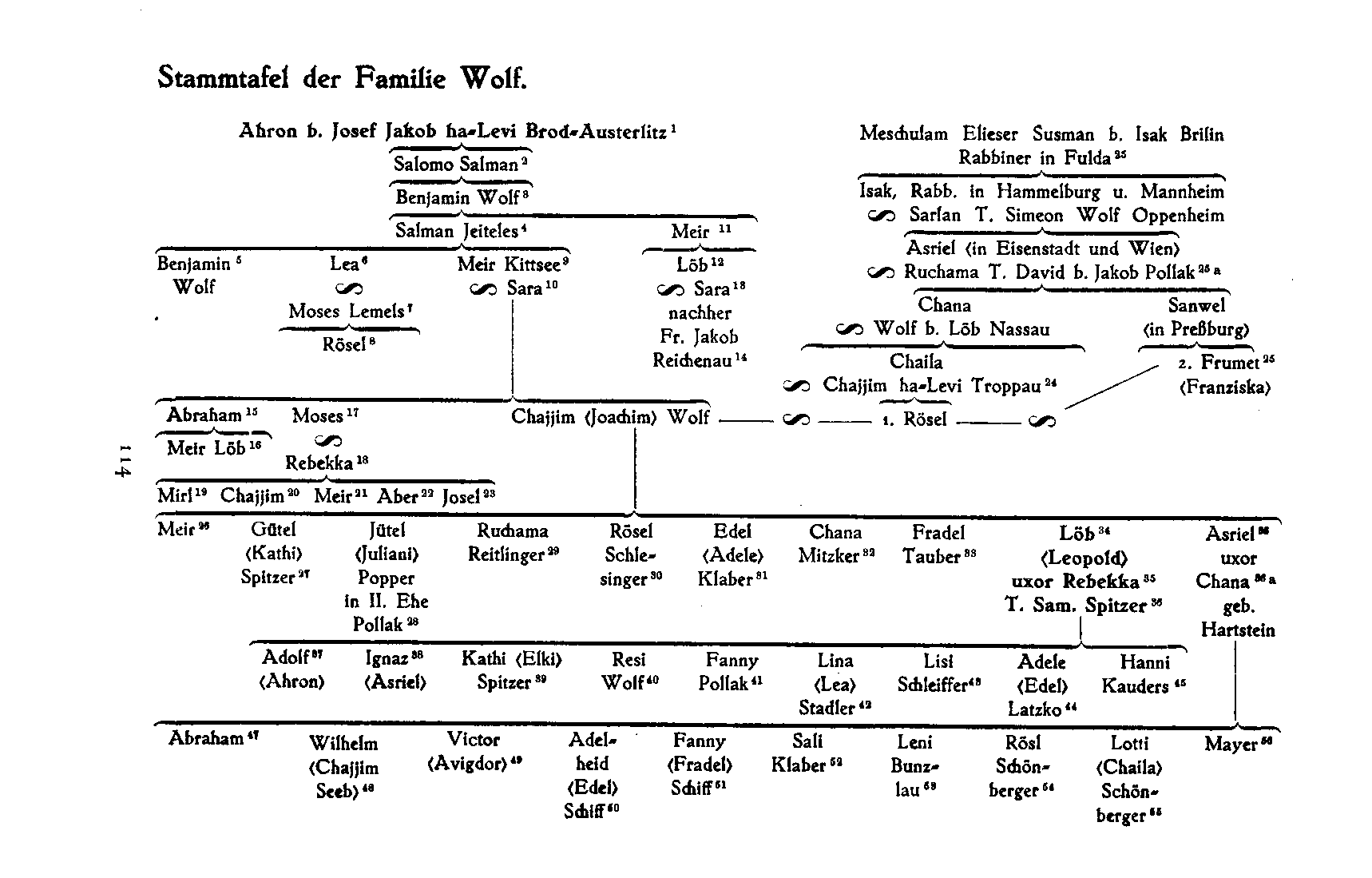
It is not generally known that Sandór Wolf - his Eisenstadt house is now a regional museum and houses one of Haydn's gorgeous organs - was the grandfather of the world-renowned potter Lucie Rie. See photos in my FLICKR site here.

Sándor Wolf (Eisenstadt Nov. 21, 1871 - Haifa Jan. 2, 1946) was a wine wholesaler, art collector and researcher. He was also a scholar/archaeologist and collaborated with Bernhard Wachstein - click here for more information - in a momentous tome on the transcriptions of the Eisenstadt cemetery: “Die Grabinschriften des alten Judenfriedhofes in Eisenstadt mit einer Studie: Die Entwicklung des jüdischen Grabsteines und die Denkmäler des Eisenstädter Friedhofes von S. Wolf (Eisenstädter Forschungen 1).

Wolf was particularly interested in ancient settlements and artefacts of the Burgenland and there is evidence that Jews had arrived in this area with the Roman Legions, well over 1,000 years before the first Jewish community settled in Eisenstadt in the 1370s.

The Esterházys took the Jewish community under their protection in 1622 when they inherited the area estates. The Jewish population increased and the fame of tiny Eisenstadt as a centre of Jewish learning and scholarship spread throughout the world.

In 2008, a gold scroll was discovered in the Burgenland, as the earliest evidence of Jewish inhabitants in the region, now part of Austria; the amulet was inscribed with a Jewish prayer and found in a Roman child’s grave dating back to the 3rd century at a burial ground in Halbturn. Read about these here.

There is a WOLF GOMPERZ RIE family archive here with many pictures.

Lucie Gomperz was the youngest child of three and the only daughter of Dr. Benjamin and Gisela Gomperz. Dr. Gomperz was a successful ear, nose and throat specialist in Vienna. Gisela Gomperz née Wolf was born into the wealthy Wolf family. The Gomperz children, who lived in Vienna, spent a lot of time at the Wolf estate in Eisenstadt.

Here is an excellent German-language article with photographs about this fascinating family, and a family tree here.

Burials in Eisenstadt cemetery illustrated here took place from 1679-1874. There is a later Jewish cemetery I did not visit on this trip.

The Israelitische Kultusgemeinde {IKG - Vienna} cemetery database lists about 1,200 burials in Eisenstadt cemetery and the names - many patronymics- are very evocative. Here are four entries:
Fr. Hindel T. Abraham ha-Levi Spitz (Fr. Elia Lichtenstadt) 5th row 223
Frumet T. Elia Zebi aus Trebitsch, Fr. Pinchas Ahron Halberstadt 07/30/1802 5th row 464
Gumpel Emmerich, Fr. Meir Preßburg (ben Mich. Lazar ben Simon Michl) Golda T. 02/27/1794 5th row 264
Jehuda Löb ben Ascher Anschel Jafe-Margulies (Schlesinger) 5th row 19

Eisenstadt was called *Asch* in Hebrew because the two Hebrew letters A(lef) and S(chin) are derived from E(A)eisenStadt. Thus, Asch may imply the family name Eisenstadt or an origin from Eisenstadt viz: Meir b. Isaac Eisenstadt [MaHaRaM A"Sh].

Read about the Eisenstadt Jewish community in these three short articles:
Jewish Encyclopedia, Beth Hatefutzot and the Jewish Virtual Library


Finally, look at my FLICKR pictures here.

Saturday, December 6, 2008

Washington DC: Arlington National Cemetery


Marlene Bishow of the Jewish Genealogy Society of Greater Washington (JGSGW) has provided information on new records added to the group's website for the "Ken Poch Index of Jews Buried in Arlington National Cemetery."

Bishow is the group's immediate past president, current ANC project manager, and will co-chair the 31st IAJGS International Conference on Jewish Genealogy in Washington, DC.

Self-proclaimed historian of Jews buried in ANC, Kenneth Poch began the project more than 10 years before his 2003 death. His family donated 12 boxes of his work to the JGSGW.

Based on that research, webmaster Ernie Fine developed the website with a Steve Morse-model search engine. Currently, there are more than 2,600 entries; an additional 600 will go online in January 2009. More than 2,000 gravemarkers photos (taken by Poch) have been scanned by volunteers and will be added with links to view them online, and new photos will also be added.

Genealogical data is being added to the database using Poch's data and that of the group's volunteers. Visitors to the website are encouraged to submit names and additional information about Jews buried in ANC. For the present, the search is limited to the names of the interred.

Here (above) is the monument for sculptor Moses J. Ezekiel.

For more information, click here. To submit information, follow contact page directions.

Sunday, November 23, 2008

Eastern Europe: Wooden Jewish tombstones

As I have often mentioned on Tracing the Tribe - The Jewish Genealogy Blog, the online Jewish Magazine offers excellent articles. The November issue has a story by Tomek Wisniewski on wooden tombstones from Eastern European Jewish Cemeteries.

The article is illustrated by photographs from Lokache 1915, Druzhkopola 1916, Kisielin 1917, Pinsk 1918, Wilkomir 1915, Ozdziutycze and Lokacze.

The introduction reads, "Tens of thousands of the most beautiful stone tombstones managed to survive in Poland, but not one single wooden one has been preserved."

With a few exceptions, small-town Jewish cemeteries in Poland 'exist' only on old maps and old photographs. Their rich artistic heritage has been lost, or survives only in fragmentary or merely symbolic form, e.g. walled cemeteries behind whose walls practically nothing is to be found. The most interesting and impressive tombstones (matzevot) have disappeared. They all met the same fate.

The Germans used them to cobble roads and pavements, to reinforce escarpments and clad the beds and banks of rivers. They were used in the construction of flights of stairs and farmers used them as sandstone knife-sharpeners. Despite these years of destruction, tens of thousands of the most beautiful stone tombstones managed to survive in Poland, but not one single wooden one has been preserved.

The author comments that Jews erected wooden markers for centuries and were usually found in the poorest localities where it was hard to find stone. They were ordinary wood, painted with the name and dates. Those with a little more money would carve in the wood the names in Hebrew.

In Polesie and around Pinsk (today Belarus, then Poland before 1939), the Jews lived in wooden houses, prayed in wooden synagogues and wooden tombstones were an old tradition.


Wooden tombstones were also used in Volhynia, Mazowsze and Wielkopolska and by the poorest Jews in larger towns such as Bialystok, Wilno and Lublin. During the First World War wooden tombstones were often erected on the graves of Jewish soldiers of the Austrian army, especially in the Beskid Niski region. During the First World War several hundred wooden Jewish tombstones in the old cemetery in Lublin (founded in 1541) were also used by Russian soldiers for firewood.

The oldest Polish wooden markers date from the 18th century, around Miejsce. The Jewish cemetery there has photographs of markers from 1771-1805, which can be seen in the collection of the Jewish Museum in Frankfurt-am-Main.

The oldest carved inscription - February 19, 1771 - reads:

Here lies a brave and honorable woman, Mrs. Chajosen, daughter of the venerable Mr. Alexander, of blessed memory. She died on Tuesday, the fifth day of Adar in the year 5531" (19 February 1771).

Photos are rare traces of these wooden markers; there are fewer than 12 photos dating from before 1939. Following years of research, Wiesniewski writes about his collection:


....[he] managed to acquire several original photographs or postcards of wooden tombstones pre-1939 from Ozdziutycze, £okacze, Droshkopol and Kisielin in Volhynia, as well as of wooden ohels with inscriptions from Piñsk in Polesie and from Wilkomierz in Lithuania, and just one photograph from Radom, dated 1941, of a wooden matsevah in the ghetto.

He describes the markers:


Wooden Jewish tombstones were usually tall and after some years had passed and the wood had begun to rot, the lower part would be cut off and the tombstone buried deeper in the ground.

According to the article, the same tradition was followed in Christian cemeteries. Eventually, the wooden marker would be removed and replaced by stone.

In existing photos, the markers were similar: long narrow wooden planks of oak or pine with little ornamentation. The narrow wood meant inscriptions and dates were truncated, abbreviated or adjusted in other ways, such as spacing. The author gives very detailed examples of inscriptions.

In the 18th century marker from Miejsce, inscrptions are brief. There are three photos containing 15 legible and almost complete inscriptions (from 1895-1913). In Kiesielin, there are two complete and one partial legible inscription detailed by the author. In Lokacze, there are six readable inscriptions. In Ozdziutycz, there are seven inscriptions in a photo. There are translated inscriptions, such as


"Here lies a modest woman, the married Berkah(?) daughter of R. Szlomo. She died the 13th day in the month of Tevet year 5671 (1911) as the abbreviated era. May her soul be bound in the bond of everlasting life."

Women are described as "modest" or "proper;" men as "perfect" or "perfect and upright." and provide only the essential details such as the name of the person, father's name, death date and the abbreviation of 1 Sam 25:29 which "May his/her soul be bound in the bond of everlasting life." At the top is "peh nun," "here lies." There are no surnames.

Read the detailed complete story at the link above. the photographs are fascinating and are from the author's collection.

A book by the author, "A History of Lost Jewish Shtetl Cemeteries" will be published by Kreator later this year.

Saturday, November 15, 2008

Warsaw: Jewish tombstone photo exhibit planned

Ruth Ellen Gruber posted on her Jewish Heritage Travel blog about an exhibition planned on misused Jewish tombstones.

The Foundation for the Preservation of Jewish Heritage in Poland has posted an announcement that it will be working with the Ethnography Museum in Warsaw to put together a photographic exhibition on a fascinating, little-examined (and rather uncomfortable) topic - the use of Jewish tombstones (mazzevot) after the Holocaust in improper, even deliberately desecratory ways.

See here for more, including photographs.

Monday, November 10, 2008

Philadelphia: Abandoned Jewish Dutch cemetery

I’m glad this week that I paid attention to my postal mail. I received a missive from Stanley Barer, president of the Association for the Preservation of Abandoned Jewish Cemeteries in Philadelphia. I had barely remembered the role of Dutch Jews in the early history of Philadelphia. According to the literature, Philadelphia Dutch Jews founded the Ashkenazi synagogue, B'nai Israel Congregation, or the Hollander Synagogue, in 1857.

In the same year, they founded The Hebrew Mutual Burial Society Cemetery in Southwest Philadelphia. The cemetery was abandoned in the 1970s due to the society’s lack of membership and funds, and taken over by the city. For years, residents living near the cemetery complained about the dilapidated conditions, but there were no means for caring for this piece of history.

Now there is a way to honor the memories of the 440 Jews buried at The Hebrew Mutual Burial Society Cemetery and celebrate the history of Dutch Jews in America. In conjunction with the Jewish Federation of Greater Philadelphia, and the VAAD, Board of Rabbis, there is now an organized effort to restore and preserve the cemetery.

I encourage you to go to: http://savejewishgraves.org/index.htm to learn more about Dutch Jewish Philadelphia, and the plans for rebuilding this historical landmark.
Rabbi Gary M. Gans

Below are some pictures from the web site:

Photos are by
Community Design Collaborative

Saturday, November 1, 2008

Netherlands: Utrecht's Jewish cemetery

Henk van Kampen, of the Netherlands, is the author of The Graveyard Rabbit of Utrecht and Het Gooi, and he's recently posted about Utrecht's Jewish cemetery, with exterior photographs and a link to others.

Visit his site to see the photographs and other postings.
On my way to the first cemetery visit since I'm a graveyard rabbit, I passed the Jewish cemetery of Utrecht. I can't read the Hebrew (I assume) text above the door, but the Dutch text on the door is clear: Toegang verboden, no admission (litt. access forbidden).

Many Jewish cemeteries are walled in and inaccessible - probably the consequence of many centuries of European antisemitism. Maybe at a later date I will ask permission to visit and photograph, but for the time being I only have a few photos from the outside. Fortunately, there are also
several photos on the website of the Utrecht archive.

Henk's destination and the subject of his next post is the graveyard of Oud Zuilen.

We hope Henk asks for permission to visit and photograph the Jewish cemetery.

He's also the author of Trace your Dutch roots, a blog about Dutch genealogy.

Tuesday, October 28, 2008

Belarus: The Dokshitsy Jewish Cemetery Project


The Friends of Jewish Dokshitsy was formed in 2005 to perpetuate the memory of the Jewish residents of Dokshitsy, Parafianov, and nearby villages in Belarus by preserving the remnants of the Jewish Cemetery in Dokshitsy and undertaking other projects consistent with this goal.

According to Aaron Ginsburg, president of the non-profit organization, the town (68 miles from Minsk) recently re-erected 134 tombstones on the Jewish cemetery grounds, destroyed in 1965. Most of the stones were buried under a road for four decades.

In 1942, the Germans killed more than 3,000 Jewish men, women and children, who were buried in a mass grave across from the cemetery. In 1964, the Jewish cemetery was destroyed and, a year later, a park was constructed there. In 2005, repairs on a street revealed the gravestones from the cemetery that had been buried since 1965.

In October 2005, Aaron received a letter from the town's officials seeking help to restore the cemetery:

“We would like to discuss with you the methods of resolving this situation in the best way so that all our actions do not seem to be blasphemy regarding the buried and also we would like to correct a mistake that was done many years ago.”

In an April 2008 article in the Providence Voice & Herald, Aaron writes about what happened as a result of that letter:

I was in the right place at the right time. I had long been interested in history and Jewish history, and more recently in my family history. I believe that the message of Judaism is about respecting each other. This extends to respecting those who preceded us. So I was ready to respond to the surprisingly friendly message from Belarus.

Joining with others, I created The Friends of Jewish Dokshitsy, Inc., and sought out descendants to help the citizens of Dokshitsy save their and our Jewish history.

In October 2007, he received another letter from the regional magistrate, asking for help in the reconstruction of the cemetery and adding:

The Dokshitsy District Soviet considers it is necessary to preserve the remnants of the Jewish Cemetery: to beautify the place, to install a memorial. ... We hope for your support and understanding in the intention to create a Memorial to the hundreds of Jewish citizens of Dokshitsy.

The dedication was on May 23, 2008, which was Lag B'Omer on the Jewish calendar. On Lag B'Omer (in 1942) and on the following days, most of the Dokshitsy ghetto's Jewish inhabitants were murdered in the town or in the ravine across the street from the Jewish cemetery and buried in a mass grave.

Friends and family from the US, Israel, South Africa and Moscow gathered for the dedication. As an example of a common emigration pattern, families from one shtetl transplanted themselves into towns where their neighbors had already settled, thus many Dokshitsy families settled in Newport (Rhode Island), Brooklyn (New York), Waterbury (Connecticut), Sheboygan (Wisconsin), Cleveland (Ohio) and Memphis (Tennessee).

Read about the group's work at Jewish Dokshitsy and view photos of the tombstones here..

Read more about the town and its history here. There is also a Dokshitz Shetlinks Page on JewishGen with more information.

Aaron seeks help in translating the inscriptions on the 134 stones. If you would like to help, have questions or need more information, contact him.

Ukraine: The Czernowitz Cemetery


The old Jewish cemetery - Czernowitz (today Cernivtsi)
The town is located at 48°17'N; 25°56'E.
Originally in Austro-Hungary, Bukovina, then Romania, it is today in Ukraine.

Researchers interested in the Czernowitz-Sadagora area will find in the Czernowitz-L Discussion Group website a diverse and extensive collection of material concerning the Jewish community, as well as a wealth of information on the cemetery, including historic and contemporary photographs along with images of burial register pages.

In fact, researchers considering a collaborative project for their shtetl will also find excellent ideas that may be adapted.

Recently, the group participated in a Cemetery Clean-up Project.

Here are links to some of the material on this project:

- A PowerPoint presentation of the 2008 Work Camp Cemetery Clean-up Project. Photos by Joanna Liss; PowerPoint by Hardy Breier.

- Report and photos from Christian Herrmann and Mimi Taylor on the 2008 International Work Camp Cemetery Clean-up Project.

- Photographs from the sucessful 2008 Cemetery Clean-up Project.

- The 2008 Czernowitz Cemetery Clean-up Project.

- The Burial Register Transcription project: A chronological description of activities by Bruce Reisch, along with images of the various burial registers connected with the first project.

- Photographs of the Czernowitz cemetery by Cornel Fleming (2004)

- Czernowitz cemetery restoration project

- The Mortuary (Leichenhalle or Zeremonienhalle) Restoration Project of Helmut Kusdat

- The Czernowitz cemetery map from Mimi Taylor Bruce Reisch's cross referenced map of the new areas compared to the old parcels at the cemetery.

- May 2006 Reunion photos of the memorial service at the Czernowitz cemetery, from Rita and Gidi Shilo.

There is much more to explore on the Czernowitz site http://czernowitz.ehpes.com/.

Thursday, October 23, 2008

Cemeteries: Stones also speak

Contributor Daniel Horowitz of Israel is originally from Caracas, Venezuela. He is the Horowitz Family Association webmaster and board member and webmaster of the International Association of Jewish Genealogical Societies (IAJGS).

Jewish cemeteries provide documents - not written on paper but on stone - that can provide critical genealogical information.

A tombstone is:
A Monument
A Work of Art
A Bit of our History

The gravestones are called, in Hebrew, matzeva (singular) or matzevot (plural) and generally contain each individual's basic information. They contain fascinating and useful information about the deceased person.

What can you learn by visiting a Jewish cemetery?

The information on the tombstone generally reveals:
- The deceased's secular given name and family name.
- The Hebrew given name.
- Hebrew name of the deceased's father.
- Date and place of birth.
- Date and place of death.
- Surviving relatives.

If the tombstone reads: "To our beloved husband, father, grandfather and brother," it means that he had a wife, children, grandchildren and brothers/siblings still living after the person died.

Tombstone of Chaim Yosef (Yonel) & Czarna (Chanka) Ciobotaro,
Herev Leet, Israel (Courtesy, Ciobotaro family)

When visiting a Jewish cemetery:

- Don't visit on a Friday (you will have less time), Saturday or Jewish holidays (it will be closed).

- Bring sufficient charts (or simple paper and pencil) to record the data.

- Bring a camera to photograph tombstones. Take some photos of the surroundings to identify the grave's location. Photograph the map of the cemetery (if there is one) to later mark the grave's exact location.

- Bring candles, matches, a prayer book, and some small stones. It is a Jewish tradition when visiting a grave to light a candle, place a small stone (for remembrance) and say a prayer.

- Bring gloves, gardening tools and old clothes. Clothing can be easily soiled or torn in an overgrown cemetery, and you may have to clean and prune around the tombstone to read it.

- Look at the graves near the one you are visiting. In general, relatives are buried in the same area. You may never know who is buried nearby unless you check the area.

- If there is a cemetery office, ask for any available additional information. You can always find somebody willing to help you.

Adapted from the study guide "Searching for My Roots" Copyright © 2005 Daniel Horowitz. All rights reserved. ISBN: 978-965-91237-1-1, Israel.