Showing posts with label Jewish Tombstones. Show all posts

Thursday, May 31, 2012

Happy Valley: Jewish cemetery in Hong Kong

I have what some people consider a weird custom of visiting Jewish cemeteries wherever I go.

It’s not that I have a relative buried there, although it may be so -you never know- it’s simply that I’m a genealogist, and this is similar to checking phone books to see how many with the Horowitz live in a town.  

Cemetery Main Entrance
In March, I was on my way to the Australasian Congress in Adelaide, Australia and stopped over in Hong Kong. In addition to the great time I had -and the wonderful people I met- I had an opportunity to meet with Howard Elias and Erica Lions, two members of the Jewish Historical Society and the people in charge of the Hong Kong Jewish cemetery.

I had never thought about a Jewish cemetery in Hong Kong - it is not documented in the JewishGen.org Jewish Online World Burial Register (JOWBR). Those who manage the cemetery are dedicated to resolving this quickly. All the gravestones have already been photographed and transcribed and will soon be available (and searchable) on the Internet.

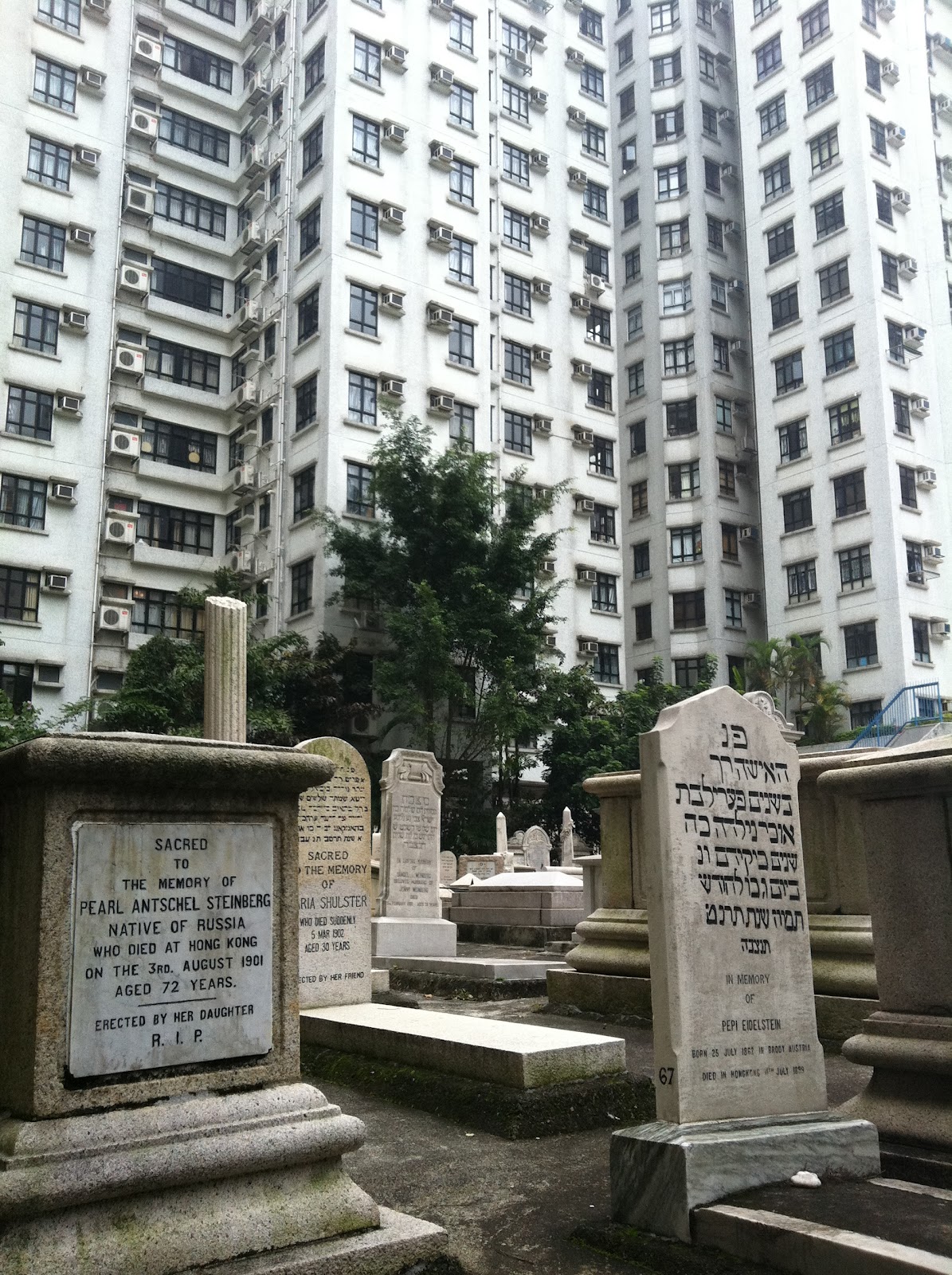
The cemetery itself is amazing. When Howard and I arrived in a taxi, I saw only huge apartment buildings and some old-style Chinese buildings (a school and a temple). Imagine my surprise when he said, “Here they are, already waiting for me,” referring to a meeting with people doing restoration and maintenance work on the grounds.

This cemetery was once outside the city, as in many big cities around the world. The land is owned by the Jewish community, which wasn’t common in Hong Kong. Once a swamp, it was given to the community by the Queen of England with the hope that people would move to the neighborhood. The area's name is Happy Valley, meant to persuade people to move there, but as this idea never prospered, they decided to use it for the cemetery.

From the street, visitors wouldn’t guess that a cemetery was hidden behind the gate and those tall buildings (see photo). Visitors can see all the gravestones, many of which are Sephardic-style, raised above the ground. The oldest one I saw was from 1875, inscribed in Hebrew. Some were so old that the inscriptions were illegible.

Name and dates tell the story of Jewish immigration to Hong Kong and such difficulties as plague and other illnesses. Although these days the committee doesn’t have more than a few burials a year, the total number of graves is about 300. Some have Hebrew inscriptions, while some recall relatives from around the world. One carries an image of the deceased, not often seen in Jewish cemeteries, although it is common among the Russian and Persian Jewish Diasporas.

Perhaps most amazing was the view of the beautiful grounds from the surrounding apartments. In Chinese culture, cemeteries are sacred and respected areas. Obviously, the living neighbors don’t mind living adjacent to the dead. After all, they may be the best neighbors: they are quiet, don’t hold loud parties and never complain.


If you travel to Hong Kong, put Happy Valley on your must-see list.

Sunday, March 22, 2009

New Jersey: The Alliance Cemetery

The Alliance Cemetery in New Jersey may be getting some help. The Garden State Preservation Trust ratified and sent to the state legislature a recommendation to fund a project to help the Jewish Federation of Cumberland County help preserve the cemetery and synagogue near Vineland.

The Alliance Colony was settled by 42 families who fled late 1800s Russian pogroms to start one of the first Jewish agricultural settlements in the US.

The federation, which handles Jewish activities in Cumberland and Salem counties, would receive more than $400,000 to restore Moshe Bayuk's brick house. Born in Eastern Europe, Bayuk was a lawyer, Jewish scholar and farmer. He died in 1932. The house is across the steet from the Alliance Synagogue. According to the plan, $50,000 in state funds would make the house the Alliance Heritage Center.

The Philadelphia Daily News story reported on the plans.

Another phase of the plan - about $4 million - would relocate two abandoned synagogues - Beth Israel, on Garton Road, in Deerfield Township, Cumberland County; and Crown of Israel, on Centerton Road, in Monroeville, Salem County - in front of the Alliance Cemetery.

Not everyone connected with the Alliance Synagogue, which still has a small congregation, is happy about the plan. Some call it a land or power grab and wonder why the Federation wants to do this now when they've ignored the place for 50 years; others fear the site will become a theme park.

In 1882, the German-Jewish philanthropist Baron Maurice de Hirsch and the Paris-based Alliance Israelite Universelle - for which the colony was named - paved the way for 42 settlers to seek out a quieter, albeit difficult life by tilling the soil instead of fighting it out among the masses in squalid, inner-city tenements.
In Pittsgrove Township and its communities - Alliance, Brotmanville, Norma, Six Points - the immigrants found acceptance and friendly neighbors. Many immigrants raised chickens and also worked in cranberry bogs and clothing factories.

The small community spread to Vineland with a Jewish population that reached about 12,000 after World War II; today the Jewish population in Salem and Cumberland counties is only 1,100. Younger generations moved away from the land in the late 50s-60s, but their parents stayed.

The story quotes US District Judge Stanley S. Brotman, whose grandfather founded the cemetery, said he supports any action to shed light on all the names whose roots were planted in South Jersey, and that the area should be given the historical significance it deserves.

A heritage center would be a fitting voice for the dead, said Vineland lawyer Jay Greenblat whose father was a carpenter and butcher in the colony. "It might be centered on Alliance, but it's something for the entire area to take part in," he said. "It's quite a story. I don't think too many people are aware of it."

Keeping watch over the generations of Jewish farmers were piles of pebbles, neatly placed atop the grave markers by loved ones who had made the trek down these scenic roads.
Alliance Cemetery has a website. Although much of it appears under construction, there are two maps and more is promised. Read the complete story at the link above.

Saturday, March 14, 2009

China: Jewish cemeteries in Harbin and Hong Kong

There were two recent mentions of Jewish cemeteries in Hong Kong and Harbin.

Ed Cohen writes in his
blog about Hong Kong's Jewish cemetery.

I wish I had seen this while I was in Hong Kong. There are lots of interesting little pockets of Jewish history in Hong Kong that can easily slip past detection. Though it might not always be an immediate association, Judaism has a pretty decent history in Asia and especially Hong Kong. A few roads on the Eastern side of Hong Kong Island (around University of Hong Kong), such as Victor Sassoon Road and Michael Kadoorie Street.
See more photos at findagrave.com

Harbin figured in this
German blog which referred to the Heidelberg University Harbin Project.

The project was carried out by the History Department, Centre for European History and Culture (ZEGK), University of Heidelberg, led by Professor Madeleine Herren in cooperation with the School of Western Studies, Heilongjiang University, guided by Professor Dan Ben-Canaan.

During the 1920s Harbin turned into a multiethnic centre in which the Jewish community played a decisive role. The Harbin Jewish Cemetery established in 1903 was located at No.54, Dongda Zhi Street. During the 1920ies it was extended and relocated to Tai’an Street. With its 2,420 m2 it was the largest among alien residents’ cemeteries at that time in Harbin. In 1958, the Chinese authorities decided to move the Jewish Cemetery to the Huang Shan Public Cemetery located at the outskirts of Harbin´s municipal boundaries. From approximate 3000 graves of which 1200 with tombstones, 853 were selected and transferred to an area of 6,532.00 square meters in an eastern suburb about 10 km from the centre of Harbin. During the Cultural Revolution, maintenance of the cemetery ceased: Slabs subsided, tombstones inclined, cracked or damaged, and some of the slabs disappeared. The Jewish community stopped functioning on December 31, 1963, and until that date 23 graves were added to the new location, bringing a total of 876 graves to the site. Maintenance was restarted in 1991, and 450 gravestones could be identified today."


Friday, March 6, 2009

Guess Who's Buried in a Jewish Cemetery? Part 3

The Historical Society of Pennsylvania runs a “Question of the Week” quiz on its website, created by technical services archivist Cary Majewicz.

One recent question was “What Philadelphia woman was rumored to be the inspiration for the Jewish heroine in Sir Walter Scott’s novel Ivanhoe?”

I knew the answer because my first job in Jewish education was as a raw teacher in the Philadelphia Hebrew Sunday School Society founded by Rebecca Gratz, the role model for this novel!

A version of the answer also appeared on March 1, 2009 in the Philadelphia Inquirer, in a section entitled “Memory Stream,” provided by the Historical Society.

In the early 1800s, Rebecca Gratz was a beautiful, cultured woman in Philadelphia’s elite class. She is rumored to have been the inspiration for the Jewish heroine in Sir Water Scott’s novel "Ivanhoe."

But Gratz was much more than a pretty face. She was a successful educator and philanthropist who provided relief to Philadelphia’s poor women and children and furthered the moral and religious education of Philadelphia’s Jewish community.

Gratz was born in Lancaster, Pennsylvania, on March 4, 1781, and her family later moved to Philadelphia. She began her charitable work at age 20.

In 1801, along with her sisters and several other women, she founded the Female Association for the Relief of Women and Children in Reduced Circumstances, a nonsectarian organization designed to assist formerly affluent women and their families who had fallen on hard times.


She expanded her work with poor women and children by establishing the Philadelphia Orphans Society (1815) and the Female Hebrew Benevolent Society (1819).

She experimented with Jewish education in 1818 by creating a small religious school for her siblings and their children; this trial provided the basis for the Hebrew Sunday School she would create some 20 years later.

Gratz never married, and instead devoted her life to charitable work. She died in 1869 and is buried in Philadelphia’s Mikveh Israel Cemetery.

Attendees of the 29th IAJGS International Conference on Jewish Genealogy in Philadelphia, August 2-7, will be able to visit her grave and those of other notable Jewish Philadelphians at the nearby Mikveh Israel Cemetery.

Rabbi Gary M. Gans

Saturday, January 17, 2009

Colorado: The mystery of the dislocated grave

Ready for a good mystery? The Intermountain Jewish News has just published an excellent Jewish mystery tale.

Here lies a tale about the past, and the mysteries in its wake.

Sit down, have some hot tea, stir the fire, make yourself comfortable on a cold winter’s night. Hear a story about events long ago transpired, people long since dead, and old tombstones mostly — but not entirely — forgotten.

A tale of the cemetery, and those who repose within it.

Not a spooky tale, mind you, although to many people cemeteries are spooky places. And not necessarily a sad tale, although most of us find graveyards to be forlorn and gloomy locales where grief and regret reign supreme.

No, this is a tale about lives lived, accomplishments achieved, decisions made — and questions asked.

A story about histories. And mysteries.

A young Denver woman, Jennifer Miklosi, was working on her master's in art history at the University of Denver some 10 years ago, working under Dr. Annette Stott, head of art history at DU.

Miklosi says it began as a course assignment with the focus on 19th century sculpture in cemeteries. She was to find a piece and analyze it from an art historian's perspective, write an artistic analysis and uncover as much of its history as possible.

She decided on Denver’s Fairmount Cemetery, filled with Victorian sculpture. After hours on the walkways, she found the piece she was looking for

It was a marble statue, in the form of what experts on the esoteric topic of cemetery sculpture call a “woman in mourning,” a female figure, wrapped in a shawl, holding a wreath of flowers and looking plaintively toward the grave below. The figure’s right hand is wrapped around the cut-off trunk of a small tree.

Miklosi was taken by the life-like expression on the figure’s face, by the realistic texture and wave of her hair, by the intricate details apparent in the hem of her shawl and the flowers in her wreath — in general, by the overall artistic excellence of the piece.

Miklosi says both the“woman in mourning” theme, and the cut-off tree — often used for a young person whose life was cut short — are seen in sculptures at Fairmount and other cemeteries.

What caught her eye was the superior workmanship, it wasn't a mass production piece like many others - so she thought it might have been commissioned. While mourning woman figures are found at Christian graves, there is usually a horizontal branch on the tree, creating a cross. This sculpture had no such branch and was an enigma. There was no indication of the sculptor anywhere, and the cemetery office had no information.

That's when Miklosi set to work as any conscientious art historian - investigating the family who owned the plot. Along the way, she became something of an art detective in pursuit of history - family history.

The young woman was Jessie Eleanor Salomon who died at the age of 19 on January 8, 1889.

She was the daughter of Hyman and Cecelia Salomon, whose graves are included in the sizable family plot at Fairmount, as are those of her siblings Eva, Oscar, Florence and Lillian, and a man, James Geoffrey McMurray, who is assumed to have been her brother-in-law. Eva and Oscar both died when quite young; Florence when considerably older; and the couple Lillian and James McMurray, apparently at an advanced age in the 1920s.

The plot holds individual tombstones for all family members interred there, plus a large central granite memorial, adorned only by a single Old English “S” and the family surname. The statue which stands at the head of Jessie’s grave is the only sculpture in the plot. No other graves, including those of her parents, boasts such a distinctive marker.

And, as suitable for the International Jewish Graveyard Rabbit, the Salomon family was Jewish, as Rabbit readers have already guessed.

Miklosi isn't Jewish and never studied local Jewish history, but her passion for this investigation turned her into an authority.

Like a good genealogist, she checked old newspapers and written histories for the Denver Jewish community and found data on the family's patriarch, Hyman Salomon, who appears in history books. Some historians believe he was the first Jew to settle in the place now known as Denver.

Born in Prussia, Salomon came to what was then known as Auraria early in 1859, making him one of the first pioneers to arrive here. His brother Frederick followed close on his heels. In short order, they set up Denver’s first-ever dry goods business, Salomon Brothers, which hop scotched over several locations in its early years.

The brothers, in partnership with a Gentile trader by the name of J. B. Doyle, then began opening up general stores in Colorado and New Mexico.With other partners, they also set up wagon trains full of provisions to help supply the new mining camps in Colorado’s high country.

They, and a third brother, Adolph, who became a successful potato farmer and merchant in Horace Greeley’s Union Colony in northern Colorado (known today as Greeley) were as authentic as Western pioneers could get. They braved confrontations with restive Indians on the eastern plains, rode hundreds of miles on horseback to distant locations, helped set up mining camps that would later become gold and silver boomtowns and outfitted US Cavalry units throughout the region.

In addition to setting up what is believed to be Denver’s first brewery, the Salomons were able to bring to the fledgling settlement of Denver both cigars and whiskey, the latter said to be considerably superior to the notorious “Taos Lightning” previously available.

The Salomons made lots of friends among Indians and white men alike, and gained reputations as plain dealers and straight shooters (denoting honest traders, not accurate gunslingers). Such terms constituted high praise indeed in the days of the Old West.


Along the way they also made lots of money with their skills and timing. Hyman and Frederick became respected citizens. Both were were proud of their Jewish heritage, helping to found the Hebrew Burial and Prayer Society, which organized Denver’s first Jewish cemetery and later evolved into the city's first synagogue, Congregation Emanuel, whre they were among the founding members.

As she uncovered information she found a letter from Hyman published in the Rocky Mountain News in 1865, in which he criticized then-territorial governor Alexander Cummings on a Thanksgiving proclamation he had issued, stressing the holiday's Christian roots.

“Are we of the Jewish persuasion included in the Proclamation for Thanksgiving, ‘requiring all good people of Colorado to assemble in their respective places of worship and render unto G-d devout Thanksgiving for the riches of His grace, manifested through His Son Jesus Christ’? If so, we have never in the United States of America seen a proclamation excluding Jews from participating. Jews do not worship G-d through Christ, and by the above proclamation, we are excluded. Respectfully yours, H.Z. Salomon.”

So, she learned that his Jewishness was important to Hyman, but here now was the mystery. Why would such a respected Jew have his and his family's graves in a section other than the Jewish part of Fairmount Cemetery? His brothers Frederick and Adolph were in the Jewish section, but Hyman's is in the general section - with very few Jewish graves.

Well, there was more, continues the story, at least five of the plot's graves were originally in the old City Cemetery, but were moved when the city decided to redevelop the land.

The Salomon graves were moved to Fairmount on April 4, 1916. Hyman’s widow, Cecilia, apparently paid for the new plot and arranged the move, although Fairmount records do not mention Jessie's statue.

There's much more, including a list of further questions that need to be answered to understand the full picture. The Denver Public Library Western History section has no record or photograph of Jessie in any newspaper article or obituary.

The newspaper is asking for help from the readers of the story.
It is possible that descendants of Hyman Shapiro (or more likely, his brother Adolph) still reside in Colorado and might possess a few family anecdotes that could shed light on the many mysteries of the grave. Such individuals are encouraged to contact the newspaper, no matter how hazy or folkloric the recollections might be.

Please read the rest of this particularly fascinating mystery of history at the link above. Let me know if you have any information that can help solve this case.

Visiting a Jewish cemetery: Experiences, emotions

Ruth Ellen Gruber's posting at JewishHeritageTravel covers emotional and mystical experiences at Jewish cemeteries, both her own and of others.
Visiting a Jewish cemetery in Europe, and particularly in East-Central Europe, can be an emotional experience.

This holds true whether you go there as a volunteer helping clean up an abandoned cemetery overgrown by weeds and trees, or as someone on a roots trip looking for a long-lost, or long-forgotten, family grave, or as a "straight" tourist interested in history or the powerful imagery of tombstone art.

In the introductory chapter of
Jewish Heritage Travel: A Guide to Eastern Europe I addressed these emotions, describing how I myself felt when I began exploring these sites.

I became absolutely mesmerized, even a little obsessed with what I was seeing. I wanted to visit, touch, see, feel as many places as I could. I almost felt it a duty. As I entered broken gates or climbed over broken walls into cemeteries where a Jew may not have set foot in years, I wanted to spread my arms and embrace them all, embrace all the tombstones, all the people buried there, all the memories.

In the first editions of the book, I added a further sentence, describing how I projected my thoughts toward these all so often forgotten places:
I'm here, I told them mentally; SOMEONE is here.

Back then, my trips were voyages of discovery. Everything was new; there was little literature on the subject, few visitors had made their way to such sites, and there were few efforts to preserve, maintain or restore them. But even today, after scholars and genealogists and tour guides have studied and mapped and documented almost everything -- I still feel the pull.
Ruth continues on to detail a Jerusalem Post story by Jonathan Gillis who took part in a restoration project of the Czestochowa (Poland) Jewish cemetery and his experiences. She includes photos (1991, 2006) of the old Jewish cemetery cemetery in Nazna, Romania - near Targu Mures - and describes her almost mystical experience there.

Read Ruth's complete post at the link above.

Monday, January 12, 2009

Ukraine: A photo essay

Here's photographer Trix Rosen's essay - and wonderful photographs - on her August 2008 trip to Ukraine.

I learned about Rosen in a posting by Ruth Ellen Gruber, with a link to Gruber's own photos of Ukraine. Rosen used Gruber's book, Jewish Heritage Travel: A Guide to Eastern Europe, to organize her trip.

Rosen writes:

For me, a first-generation American, an artist, a photojournalist, and a historical preservation photographer, they have become a portal to rediscovering my own Jewish heritage.

She offers evocative photograph, arranged in albums, of the cemeteries located in Chernivtsi, Sadhora, Shahhorod, Kremenets, Sataniv and Medzhybizh.

Bet Hayyim - The House of Life

I could see hundreds of stones jutting out of the hills in all directions, leaning this way and that like silent figures pushing out toward the sun. In the distance, the worn grey, beige and brown graves were stark monuments, reminders of the people who had lived out their lives in this place, and died.

The cemeteries seemed to be swallowed up by nettles, wildflowers and hills of exuberant goldenrod. Where the ground had shifted, the displaced stones appeared as monoliths from some ancient civilization, left by time to lean against one another.

In August 2008 I travelled to the Ukraine for the first time, to meet two of my friends and to visit Odessa, the birthplace of my father. My two-week visit became an exploration into the history of the once vast community of Eastern European Jews and the relics they had left behind.

This odyssey started in Kiev at the ravine in Babi Yar, and took me to the tombs of Rabbi Nachman in Uman and the Ba’al Shem Tov in Medzhybizh, two historic Hasidic pilgrimage sites associated with the Kabbalah. I crisscrossed the heartland, over 2000 kilometers, to visit cities, towns, and shtetls, and to photograph the carved tombstones in cemeteries dating back to the 1400’s.
...

She describes the tombstones and their carvings of animals and symbols.

Some epitaphs were intricately carved, the stones decorated in an elaborate Jewish script covering the entire surface; others held only the most minimal outline of the Star of David. Massive, six-foot-high sculptures of tree trunks with their branches cut off towered over the simpler stones. Some retained a residue of ochre and blue paint, (perhaps the final touch of the engravers and stonecutters), while others were covered only in lichen and moss. ...
The cemeteries - called Bet Hayyim (Hebrew for House of Life) - survived pogroms and Nazi murders of Jews who lived nearby. Read the complete essay at the link above.

Sunday, January 11, 2009

Cleveland: Outside of the box

Arlene Fine of the Cleveland Jewish News is doing a series on women with unusual occupations. This Friday, it was the turn of Karen Gutner of Classic Monuments, who helps families select and personalize headstones.

“Sometimes I feel more like a psychologist than a salesperson,” says the Lyndhurst resident. “I get a lot of white-knuckle flyers walking in the door. I understand that anything relating to death can be scary.”

After they get over their uneasiness, most of Gutner’s clients have sticker shock. The average headstone can run anywhere from $500 to $5,000, and that does not include the cemetery fee for the cement installation to hold the headstone in place.

When some clients learn the cost of the stone is not included in the funeral expenses paid months before, “they are not happy,” Gutner admits. “I try to soften the blow by suggesting locally quarried rather than imported granite.”

But that is not the only issue people must consider. Every cemetery or cemetery association has rules as to the height and width, color and shape of a tombstone. Gutner keeps a handbook listing all requirements and restrictions as a verifiable reference.

“Some family members come in with requests for grandly designed monuments,” she says. “They are astonished and often angry when I tell them a simple granite marker is all that is permitted on that particular plot of land.”

After a headstone is selected, the wording can be the next hurdle.

Gutner says that in the case of a woman who has married more than once, the choice of wording can be a problem when everyone gets into the act (children, stepchildren, surviving husband/s or parent/s) as to what names will appear on the stone.

“Sometimes I have to act as a referee as the gansa mishpochah (whole family) have heated arguments at my desk over the tombstone inscription.” In the end, she adds, whoever is paying for the tombstone or monument usually wins.”
The article ends with Gutner's pleas for individuals to visit a memorial business and pre-pay for the tombstone when prepaying for a funeral.

Friday, January 2, 2009

Guess who’s buried in a Jewish cemetery? Part 2

This is the second post in this series.

While performing yet another funeral, I spotted the rare breed of a flock of aging flower children wending their way among the graves. I was in the Haym Salomon Memorial Park in Frazer, PA outside of Philadelphia.

The women in flowing dresses wearing granny glasses were not there to visit their dear old Granny! Neither were the guys in tie-died shirts, dying. In fact, they were making a pilgrimage to the grave of the rocker, Jim Croce.

Jim Croce had three highly successful albums and several hit singles including, "You Don't Mess Around With Jim," "Operator," "Bad, Bad Leroy Brown," "I Got A Name," "Time In A Bottle," and "I'll Have To Say I Love You In A Song." His career came to a tragic end in 1973 when he and his fellow musicians boarded a private plane in Louisiana to travel to a show in Texas. The plane crashed in Natchitoches, Louisiana shortly after takeoff killing everyone on board.

Still, Jim Croce the Italian Catholic, is buried in a Jewish cemetery? Well, it seems he converted to Judaism when he married his wife, Ingrid Jacobson, so he had the same right of every Jew, whether Jewish from birth or converted, to be buried in a Jewish cemetery.

Here's the marker that attracts so many visitors.


Croce’s last album for ABC was called, “I Got a Name.” So, I guess it is fitting that his metal marker merely shows his name and the years of his life, 1943-1973.

Typically a Hebrew name would have been accepted by Jim at his conversion, but it is not included. The lack of his Hebrew name is not a tremendous loss to genealogists, however.

His paternal Hebrew name would have listed him as the son of Abraham Our Father (as is the case for all converts who are linked to the Biblical Patriarch as their spiritual father) rather than his biological father.

Rock On!

Rabbi Gary M. Gans