There is an ongoing dispute between the Sephardic and Ashkenazi communities in Turkey because the Sephardic cemeteries are running out of space.
Ashkenazim - in Turkey since the 1400s - make up only 5% of the Jewish community, but the two communities are extensively intermarried. The Sephardic community grew after Spanish Jews were welcomed at the time of the 1492 Expulsion.
The office of the Chief Rabbi (Hakham Bashi) placed an advertisement in the daily Jewish paper stating that Sephardim were reserving plots in Ashkenazi cemeteries and vice versa.
The rabbi warned that this is a big problem and those considering such plots should consult him first, while the Ashkenazi organization says, in response, that their door is open to everyone.
The main problem is that Sephardim and Ashkenazim married to each other want to be buried side by side, but the Sephardi cemeteries are running out of room.
There are six Sephardic and one Ashkenazi cemetery, with the Ulus Cemetery most popular.
Read the complete Hurriyet article here.
Showing posts with label Jewish History. Show all posts
Showing posts with label Jewish History. Show all posts
Sunday, July 12, 2009


Monday, July 6, 2009
Michigan: Jewish cemetery nominated for NRHP
Temple Beth Israel Cemetery (Jackson, Michigan) has been nominated for inclusion in the National Register of Historic Places
Temple member Nancy Demeter spearheaded the process and researched its history. It was first approved by the State Historic Preservation Board, which forwarded the nomination to the National Park Service. Approval is expected.
Read more here.
When Denni and Carl Glick of Jackson walk through Temple Beth Israel Cemetery, it's like taking a step back in time.Jews arrived in Jackson in 1842, but the small community meant a synagogue could not be constructed until the early 1860s. The cemetery was dedicated in 1859. There are more than 270 burials which represent four or five generations of community families.
The two wander through the 1-acre burial plot on N. West Avenue, just south of the railroad tracks, and reminisce on the congregation's history, as told through inscriptions etched on the gravestones of family and friends.
Temple member Nancy Demeter spearheaded the process and researched its history. It was first approved by the State Historic Preservation Board, which forwarded the nomination to the National Park Service. Approval is expected.
Read more here.
Sunday, May 31, 2009
Macedonia: Shtip Jewish cemetery project
Did you know there was a Jewish cemetery in Shtip, eastern Macedonia?
According to BalkanTravellers.com, in 1512, 38 Jewish families were the first to be recorded in Shtip. In 1943, all 560 Jews from the city's Jewish quarter were deported to the Treblinka death camp.
The cemetery's reconstruction and conservation project will soon begin under the auspices of the Institute and Museum of Shtip, headed by Zaran Chitkushev.
Chitkushev also said that it is in contact with the European community in Macedonia and that an Israeli archaelogist will be invited to work on the project.
According to BalkanAnalysis, here's more on the Jewish presence in Macedonia.
The Jewish presence in Macedonia is ancient., as evidenced in the central Macedonian Roman city of Stobi, which has traces of a 1st century BCE synagogue.
Roman Empire trade, commerce and travel brought together peoples from around the empire. The Jewish community remained through Slavic migration in the 6th-7th centuries and Byzantine sources record Jewish references.
The Spanish Inquisition, resulting in the 1492 Expulsion, brought a new population of Ladino-speaking Sephardim to Macedona and other Ottoman-held Balkan territory, such as Saloniki (Greece). The refugees used their commercial and technical knowledge to improve the economy and other aspects of life, including the Sultan's military technology, and the community flourished under the Ottomans.
In 1941, when the Bulgarian Army invaded in a Nazi alliance, some 20,000 Jews were deported from Bulgarian Army-controlled areas in Macedonia, northern Greece, southern Serbia and Bulgaria.
While Jews in Bulgaria were saved, the quota was filled with Jews who lived in other places. Entire communities, such as 7,200 from then-Yugoslav Macedonia, were deported to death camps.
According to BalkanTravellers.com, in 1512, 38 Jewish families were the first to be recorded in Shtip. In 1943, all 560 Jews from the city's Jewish quarter were deported to the Treblinka death camp.
The cemetery's reconstruction and conservation project will soon begin under the auspices of the Institute and Museum of Shtip, headed by Zaran Chitkushev.
"The money for the reconstruction project was secured by the government, and with the project the Jewish cemetery will become a monument of culture,” Zaran Chitkushev, head of the Shtip Institute and Museum told the Dnevnik newspaper today.The to-be-fenced project, covering 14,000 square meters, also includes parking lots, pedestrian walkways, benches and monuments.
Chitkushev also said that it is in contact with the European community in Macedonia and that an Israeli archaelogist will be invited to work on the project.
According to BalkanAnalysis, here's more on the Jewish presence in Macedonia.
The Jewish presence in Macedonia is ancient., as evidenced in the central Macedonian Roman city of Stobi, which has traces of a 1st century BCE synagogue.
Roman Empire trade, commerce and travel brought together peoples from around the empire. The Jewish community remained through Slavic migration in the 6th-7th centuries and Byzantine sources record Jewish references.
The Spanish Inquisition, resulting in the 1492 Expulsion, brought a new population of Ladino-speaking Sephardim to Macedona and other Ottoman-held Balkan territory, such as Saloniki (Greece). The refugees used their commercial and technical knowledge to improve the economy and other aspects of life, including the Sultan's military technology, and the community flourished under the Ottomans.
In 1941, when the Bulgarian Army invaded in a Nazi alliance, some 20,000 Jews were deported from Bulgarian Army-controlled areas in Macedonia, northern Greece, southern Serbia and Bulgaria.
While Jews in Bulgaria were saved, the quota was filled with Jews who lived in other places. Entire communities, such as 7,200 from then-Yugoslav Macedonia, were deported to death camps.
Monday, May 18, 2009
Michigan: Jewish Cemetery Index
Are you looking for family members who may have been buried in a Jewish cemetery in Michigan? This resource may help your quest.
The Irwin I. Cohn Michigan Jewish Cemetery Index provides burial information for more than 64,000 Jews who died between the mid-1800's and 1999.
While many cemeteries were very helpful in allowing access to their records, old, damaged, incomplete or missing records made the task of compiling a complete index impossible. As a result, the database does not contain every name.
This database is considered a "first stop" for researchers. If you can't find a specific individual, he or she may have been buried in another Jewish cemetery in the state.
Here's a screenshot of what a search retrieves:
The Irwin I. Cohn Michigan Jewish Cemetery Index provides burial information for more than 64,000 Jews who died between the mid-1800's and 1999.
While many cemeteries were very helpful in allowing access to their records, old, damaged, incomplete or missing records made the task of compiling a complete index impossible. As a result, the database does not contain every name.
This database is considered a "first stop" for researchers. If you can't find a specific individual, he or she may have been buried in another Jewish cemetery in the state.
Here's a screenshot of what a search retrieves:

The index is a work in progress and information is added as received.
Since your ancestor might have been buried at a different cemetery, there is a list of cemeteries at the site. There are 36 cemeteries, each with a link. Contact them for more information.
For more information, visit the JewishGen Online Worldwide Burial Registration site.
For information on individuals who may have died more recently than 1999, visit the Detroit Jewish News obituaries.
Matilda Brandwine is the founder and honorary chair of this effort. Thanks to her incredible insight, she began researching Jewish residents buried in Detroit metropolitan cemeteries.
She and her volunteers gathered names, walked through cemeteries, recorded names from deteriorating headstones. The goal was that no one would be forgotten. Genealogists from around the world, with links to Detroit, are happy that this inspiration has provided a searchable database accessible to anyone with an Internet connection.
For more Michigan assistance, contact the Jewish Genealogical Society of Michigan here.
Wednesday, April 1, 2009
Ukraine: Uzhgorod mass grave located
According to the JTA, A Nazi-era mass grave for 200 Jews has been located in Uzhhorod (Uzhgorod) , a western Ukraine city that was part of Hungary prior to WWII, and then known as Ungvar. The city is on the Slovakia/Ukraine border.
The city's chief rabbi, Mendel Teichman, recently discovered an open area in the local Jewish cemetery. It was not fenced; there were no headstones.
Historical documents revealed the site was a mass grave for more than 200 Jews killed by the Nazis during the Holocaust.
Teichman went to the Rabbinical Center of Europe with the news. The RCE is now seeking relatives of those murdered to seek funding to build a fence and a memorial.
The city's chief rabbi, Mendel Teichman, recently discovered an open area in the local Jewish cemetery. It was not fenced; there were no headstones.
Historical documents revealed the site was a mass grave for more than 200 Jews killed by the Nazis during the Holocaust.
Teichman went to the Rabbinical Center of Europe with the news. The RCE is now seeking relatives of those murdered to seek funding to build a fence and a memorial.
Sunday, March 22, 2009
New Jersey: The Alliance Cemetery
 The Alliance Cemetery in New Jersey may be getting some help. The Garden State Preservation Trust ratified and sent to the state legislature a recommendation to fund a project to help the Jewish Federation of Cumberland County help preserve the cemetery and synagogue near Vineland.
The Alliance Colony was settled by 42 families who fled late 1800s Russian pogroms to start one of the first Jewish agricultural settlements in the US.
The federation, which handles Jewish activities in Cumberland and Salem counties, would receive more than $400,000 to restore Moshe Bayuk's brick house. Born in Eastern Europe, Bayuk was a lawyer, Jewish scholar and farmer. He died in 1932. The house is across the steet from the Alliance Synagogue. According to the plan, $50,000 in state funds would make the house the Alliance Heritage Center.
The Philadelphia Daily News story reported on the plans.
Another phase of the plan - about $4 million - would relocate two abandoned synagogues - Beth Israel, on Garton Road, in Deerfield Township, Cumberland County; and Crown of Israel, on Centerton Road, in Monroeville, Salem County - in front of the Alliance Cemetery.
Not everyone connected with the Alliance Synagogue, which still has a small congregation, is happy about the plan. Some call it a land or power grab and wonder why the Federation wants to do this now when they've ignored the place for 50 years; others fear the site will become a theme park.
In 1882, the German-Jewish philanthropist Baron Maurice de Hirsch and the Paris-based Alliance Israelite Universelle - for which the colony was named - paved the way for 42 settlers to seek out a quieter, albeit difficult life by tilling the soil instead of fighting it out among the masses in squalid, inner-city tenements.In Pittsgrove Township and its communities - Alliance, Brotmanville, Norma, Six Points - the immigrants found acceptance and friendly neighbors. Many immigrants raised chickens and also worked in cranberry bogs and clothing factories.
The small community spread to Vineland with a Jewish population that reached about 12,000 after World War II; today the Jewish population in Salem and Cumberland counties is only 1,100. Younger generations moved away from the land in the late 50s-60s, but their parents stayed.
The story quotes US District Judge Stanley S. Brotman, whose grandfather founded the cemetery, said he supports any action to shed light on all the names whose roots were planted in South Jersey, and that the area should be given the historical significance it deserves.
A heritage center would be a fitting voice for the dead, said Vineland lawyer Jay Greenblat whose father was a carpenter and butcher in the colony. "It might be centered on Alliance, but it's something for the entire area to take part in," he said. "It's quite a story. I don't think too many people are aware of it."
Keeping watch over the generations of Jewish farmers were piles of pebbles, neatly placed atop the grave markers by loved ones who had made the trek down these scenic roads.Alliance Cemetery has a website. Although much of it appears under construction, there are two maps and more is promised. Read the complete story at the link above.
Saturday, March 14, 2009
China: Jewish cemeteries in Harbin and Hong Kong
There were two recent mentions of Jewish cemeteries in Hong Kong and Harbin.
Ed Cohen writes in his blog about Hong Kong's Jewish cemetery.
Harbin figured in this German blog which referred to the Heidelberg University Harbin Project.
The project was carried out by the History Department, Centre for European History and Culture (ZEGK), University of Heidelberg, led by Professor Madeleine Herren in cooperation with the School of Western Studies, Heilongjiang University, guided by Professor Dan Ben-Canaan.
Ed Cohen writes in his blog about Hong Kong's Jewish cemetery.
I wish I had seen this while I was in Hong Kong. There are lots of interesting little pockets of Jewish history in Hong Kong that can easily slip past detection. Though it might not always be an immediate association, Judaism has a pretty decent history in Asia and especially Hong Kong. A few roads on the Eastern side of Hong Kong Island (around University of Hong Kong), such as Victor Sassoon Road and Michael Kadoorie Street.See more photos at findagrave.com
Harbin figured in this German blog which referred to the Heidelberg University Harbin Project.
The project was carried out by the History Department, Centre for European History and Culture (ZEGK), University of Heidelberg, led by Professor Madeleine Herren in cooperation with the School of Western Studies, Heilongjiang University, guided by Professor Dan Ben-Canaan.
During the 1920s Harbin turned into a multiethnic centre in which the Jewish community played a decisive role. The Harbin Jewish Cemetery established in 1903 was located at No.54, Dongda Zhi Street. During the 1920ies it was extended and relocated to Tai’an Street. With its 2,420 m2 it was the largest among alien residents’ cemeteries at that time in Harbin. In 1958, the Chinese authorities decided to move the Jewish Cemetery to the Huang Shan Public Cemetery located at the outskirts of Harbin´s municipal boundaries. From approximate 3000 graves of which 1200 with tombstones, 853 were selected and transferred to an area of 6,532.00 square meters in an eastern suburb about 10 km from the centre of Harbin. During the Cultural Revolution, maintenance of the cemetery ceased: Slabs subsided, tombstones inclined, cracked or damaged, and some of the slabs disappeared. The Jewish community stopped functioning on December 31, 1963, and until that date 23 graves were added to the new location, bringing a total of 876 graves to the site. Maintenance was restarted in 1991, and 450 gravestones could be identified today."
Friday, March 13, 2009
Mass Graves: Babi Yar and former Soviet territory sites
Numerous mass graves are located throughout Ukraine and in the eastern territories of the former Soviet Union.
Created by Nazi German and local collaborators, the principal objective of the Einsatzgruppen (a mobile killing task force) was the annihilation of Jews, Gypsies and Soviet political commissars. As a result, 1.3-1.5 million Jews were killed between 1941-1943.

Created by Nazi German and local collaborators, the principal objective of the Einsatzgruppen (a mobile killing task force) was the annihilation of Jews, Gypsies and Soviet political commissars. As a result, 1.3-1.5 million Jews were killed between 1941-1943.

Two memorials mark the area of the Babi Yar Massacre. The first erected did not specifically mention Jews as victims although a commemorative plaque in Yiddish was added later. This second memorial, in the form of a menorah, was erected by members of the Jewish community to specifically commemorate the Jewish victims who were murdered at Babi Yar.
Babi Yar is a ravine in Kiev, Ukraine where 33,771 victims were systematically murdered September 29-30, 1941. The Babi Yar massacre was the largest single mass killing and is considered the largest single massacre in the history of the Holocaust. In the months that followed, thousands more were seized and taken to Babi Yar where they were shot. It is estimated that more than 100,000 people, mostly Jewish civilians, were murdered by the Nazis there during World War II.
According to a report published in 2005 by the U.S. Commission for the Preservation of America’s Heritage Abroad, over 550 additional mass gravesites have been identified throughout the eastern territories of the former Soviet Union. (LEFT) Located near Babi Yar, this gravestone in Lukyanofka Jewish Cemetery reads in Hebrew and in Russian: M(alka) Leah Shindelman 1886-1956, Srulig Yosevich 1911-1941, Raisa Yosovna 1917-1941. The photos are Malka and her son Srulig.
Malka Leah Karger SHINDELMAN died a natural death and was buried at the Lukyanofka Cemetery in Kiev.
Her photo appears on the gravestone, which is not a Jewish custom. During the Soviet era, it was a national tradition, regardless of religious affiliation, for Russians to include a personal photo on gravestones.
Flowers are not customarily left upon Jewish graves either, but on Russian Jewish graves, it also remains a common practice to see carnations representing a Soviet-era tradition.
Malka survived the war by fleeing from Berdichev, Ukraine on a train to Lake Balkash, Kazakhstan. When Bronia Shindelman Brenner erected Malka’s gravestone in 1956, she added a second photo to the stone as well as the names of two of Malka’s adult children. She did this to commemorate her siblings, Ruchel Shindelman AVRUM and Srulig SHINDELMAN, who were Shoah victims.
Srulig was last seen alive in the Jewish Prisoner of War (POW) camp adjacent to Babi Yar. One of the only 13 Jewish survivors of Babi Yar and a relative of ours, Yakov KAPER wrote in his memoir - “Thorny Road” - about last seeing Srulig alive. Yakov escaped from the P.O.W. camp; Srulig chose not to accompany him and was never seen again.
Ruchel was last known to be alive in the shtetl of Ruzhin, Ukraine in 1941 when the German Wehrmacht occupied the region. 24 years old and pregnant with her first child, it is unknown how she perished, but there is a mass grave in Ruzhin where Jews were killed. She is presumably buried in it. (RIGHT) Mass graves in small rural communities have simple markers or none at all. This one in Lyubar, Ukraine was placed in the early '90s by Jewish relatives of those murdered. A second marker was erected nearby to commemorate partisans. Low metal fences surround both mass graves.
Resources for documenting mass grave victims in the former Soviet Union are scarce. These possible sources include Yizkor memorial books, Yad Vashem's Central Database of Shoah Victims' Names and materials at the U.S. Holocaust Memorial Museum (USHMM).
The Extraordinary State Commission to Investigate German-Fascist Crimes Committed on Soviet Territory housed at both the USHMM in Washington, DC and at Yad Vashem in Israel, is a compilation of testimonies from residents after the war and lists victim and collaborator names by town. The sequence of local events during the War is often detailed in these files.
Pulitzer Prize winning author Richard Rhodes published Masters of Death: The SS-Einsatzgruppen and the Invention of the Holocaust, which includes a detailed account of Einsatzgruppen activities and includes an extensive bibliography of materials in German archives.
Other historical books about Babi Yar and the mass graves include Anatoly Kuznetsov’s Babi Yar: A Document in the Form of a Novel, The Black Book by Ilya Ehrenburg and Vasily Grossman, The Holocaust in the Soviet Union by Lujan Dobroszycki and Jeffrey Gurock, and French Catholic priest Father Patrick Desbois’ recent memoir, The Holocaust by Bullets: A Priest's Journey to Uncover the Truth Behind the Murder of 1.5 Million Jews, which uses forensic evidence, eyewitness accounts and archival research to document the murders of Jews in the former Soviet Union.
Father Desbois will be the keynote speaker at the 29th IAJGS International Conference on Jewish Genealogy August 2-7, 2009 in Philadelphia, PA.
Alsace: Hegenheim cemetery photographs
Photographer Vincent de Groote only uses black-and-white film, and his evocative photos of the abandoned cemetery at Hegenheim in Alsace demonstrates the site's desolation.
To see his photographs, click here
To see his photographs, click here
Friday, March 6, 2009
Guess Who's Buried in a Jewish Cemetery? Part 3
 The Historical Society of Pennsylvania runs a “Question of the Week” quiz on its website, created by technical services archivist Cary Majewicz.
One recent question was “What Philadelphia woman was rumored to be the inspiration for the Jewish heroine in Sir Walter Scott’s novel Ivanhoe?”
I knew the answer because my first job in Jewish education was as a raw teacher in the Philadelphia Hebrew Sunday School Society founded by Rebecca Gratz, the role model for this novel!
A version of the answer also appeared on March 1, 2009 in the Philadelphia Inquirer, in a section entitled “Memory Stream,” provided by the Historical Society.
In the early 1800s, Rebecca Gratz was a beautiful, cultured woman in Philadelphia’s elite class. She is rumored to have been the inspiration for the Jewish heroine in Sir Water Scott’s novel "Ivanhoe."
But Gratz was much more than a pretty face. She was a successful educator and philanthropist who provided relief to Philadelphia’s poor women and children and furthered the moral and religious education of Philadelphia’s Jewish community.
Gratz was born in Lancaster, Pennsylvania, on March 4, 1781, and her family later moved to Philadelphia. She began her charitable work at age 20.
In 1801, along with her sisters and several other women, she founded the Female Association for the Relief of Women and Children in Reduced Circumstances, a nonsectarian organization designed to assist formerly affluent women and their families who had fallen on hard times.

She expanded her work with poor women and children by establishing the Philadelphia Orphans Society (1815) and the Female Hebrew Benevolent Society (1819).
She experimented with Jewish education in 1818 by creating a small religious school for her siblings and their children; this trial provided the basis for the Hebrew Sunday School she would create some 20 years later.
Gratz never married, and instead devoted her life to charitable work. She died in 1869 and is buried in Philadelphia’s Mikveh Israel Cemetery.
 Attendees of the 29th IAJGS International Conference on Jewish Genealogy in Philadelphia, August 2-7, will be able to visit her grave and those of other notable Jewish Philadelphians at the nearby Mikveh Israel Cemetery.
Rabbi Gary M. Gans
Sunday, February 22, 2009
Malta: Controversy over Jewish catacomb
The Times of Malta covered a brewing controversy over Jewish remains found in Rabat catacombs.
The Jewish catacombs are part of the St Paul's catacombs in Rabat, discovered at the end of the 19th century and dating to the late Roman period some 1,500 years ago.
The Maltese Jewish community called in international experts from Israel and the US to provide proper burials according to Jewish law, and the controversy began.
The Jewish community's representative, Lawrence Attard Bezzina, denied the delegation entered unlawfully.
Additional meetings are planned. For some idea of how the paper's readers feel about the issue, take some time to read the comments to the article.
Read the complete article at the link above.
The Jewish catacombs are part of the St Paul's catacombs in Rabat, discovered at the end of the 19th century and dating to the late Roman period some 1,500 years ago.
The Maltese Jewish community called in international experts from Israel and the US to provide proper burials according to Jewish law, and the controversy began.
The Jewish catacombs in Rabat were at the centre of controversy in recent days after Heritage Malta called in police when a Jewish religious delegation allegedly entered the site without authorisation.The visit of the delegation was confirmed by CEO of Heritage Malta, Luciano Mulè Stagno, who said a police report was made a policeman place on guard outside the entrance.
The Jewish community in Malta is demanding that the human bones found inside the catacombs are given a proper burial according to Jewish rites.
A Jewish delegation made up of at least 10 experts, Rabbis and archaeologists from Israel and the US was brought over to Malta by the Jewish community to carry out the burial.
The Jewish community's representative, Lawrence Attard Bezzina, denied the delegation entered unlawfully.
"We were scheduled to meet Heritage Malta and the Superintendence of Cultural Heritage at the site. The gate was open and since it was raining, the delegation entered into the property to be shielded from the rain. The moment they were asked to leave by the person on guard they immediately left," he said insisting that at no time did they dispute the instructions given to them.Attard Bezzina and Mulè Stagno said both sides were in talks to find a solution to respect the requests of the Jewish community which is in line with Maltese laws, because it is an important and unique archaeological site
Mr Attard Bezzina said the Jewish community had long been asking the Maltese authorities to grant them the right to give the human remains a proper burial. "The bones are scattered around and for us that is a sacrilege. We brought over experts from Israel and the US to work under the supervision of the superintendence so that the remains are granted a proper burial," Mr Attard Bezzina said.
According to Jewish rites, Jewish remains should be handled by Jewish people.
"The catacombs are also the only evidence of the presence of a Jewish community in Malta at the time. It is an important archaeological site for us," Dr Mulè Stagno said. He said Heritage Malta insisted that everything should remain on site and that the site remained within the jurisdiction of the State.The site may be government property but the Jewish community says the bones are not.
"We cannot permit human remains to be left uncovered and scattered around. We want to find a place in the catacombs themselves in agreement with the agency and give the bones a proper burial. We are not asking for the catacombs to be closed or barred to the public," Mr Attard Bezzina said.
Additional meetings are planned. For some idea of how the paper's readers feel about the issue, take some time to read the comments to the article.
Read the complete article at the link above.
UK: Historic Jewish cemetery seeks lottery funding

Restoring Jewish cemeteries through lottery funding is a possibility in the UK.
According to the Liverpool Echo, the city's historic Deane Road Jewish cemetery has applied for lottery funding to aid its restoration.
According to the Liverpool Echo, the city's historic Deane Road Jewish cemetery has applied for lottery funding to aid its restoration.
Deane Road Jewish cemetery in Kensington is the final resting place of some of Liverpool’s best-known entrepreneurs including David Lewis, pioneer of Lewis’s, and Moses Samuel, founder of H Samuel. The cemetery, which has around 750 gravestones, opened in 1837 but the last burial was in 1929 and it had become derelict before a new campaign to refurbish it was launched three years ago.Patrons include Liverpool solicitor Rex Makin, Lord Lieutenant Dame Lorna Muirhead, and well known actress (and Jewish genealogist) Miriam Margolyes. The group has put in a bid for £220,000 which should fund a total restoration, including replacement, repair or refurbishment of boundary walls, gateposts, railings and front archway, as well as to re-erect all gravestones in good condition.
The Old Liverpool Hebrew Congregation owns the site, which has an ornate Greek-revival style archway entrance and a driveway flanked by cast iron railings.
Burials include Liverpool's first Jewish mayor Charles Mozley, and painter John Raphael Isaac. For more on notable Sephardi and Ashkenazi personalities who rest in Deane Road, click here.
These detailed biographies include family histories, illustrations, links, and other grave references.
It is hoped once restoration is complete, the cemetery will be added to Liverpool’s heritage trail.
It is hoped once restoration is complete, the cemetery will be added to Liverpool’s heritage trail.
Saturday, January 17, 2009
Colorado: The mystery of the dislocated grave
Ready for a good mystery? The Intermountain Jewish News has just published an excellent Jewish mystery tale.
A young Denver woman, Jennifer Miklosi, was working on her master's in art history at the University of Denver some 10 years ago, working under Dr. Annette Stott, head of art history at DU.
Miklosi says it began as a course assignment with the focus on 19th century sculpture in cemeteries. She was to find a piece and analyze it from an art historian's perspective, write an artistic analysis and uncover as much of its history as possible.
She decided on Denver’s Fairmount Cemetery, filled with Victorian sculpture. After hours on the walkways, she found the piece she was looking for
Miklosi says both the“woman in mourning” theme, and the cut-off tree — often used for a young person whose life was cut short — are seen in sculptures at Fairmount and other cemeteries.
What caught her eye was the superior workmanship, it wasn't a mass production piece like many others - so she thought it might have been commissioned. While mourning woman figures are found at Christian graves, there is usually a horizontal branch on the tree, creating a cross. This sculpture had no such branch and was an enigma. There was no indication of the sculptor anywhere, and the cemetery office had no information.
That's when Miklosi set to work as any conscientious art historian - investigating the family who owned the plot. Along the way, she became something of an art detective in pursuit of history - family history.
The young woman was Jessie Eleanor Salomon who died at the age of 19 on January 8, 1889.
And, as suitable for the International Jewish Graveyard Rabbit, the Salomon family was Jewish, as Rabbit readers have already guessed.
Miklosi isn't Jewish and never studied local Jewish history, but her passion for this investigation turned her into an authority.
Like a good genealogist, she checked old newspapers and written histories for the Denver Jewish community and found data on the family's patriarch, Hyman Salomon, who appears in history books. Some historians believe he was the first Jew to settle in the place now known as Denver.
Along the way they also made lots of money with their skills and timing. Hyman and Frederick became respected citizens. Both were were proud of their Jewish heritage, helping to found the Hebrew Burial and Prayer Society, which organized Denver’s first Jewish cemetery and later evolved into the city's first synagogue, Congregation Emanuel, whre they were among the founding members.
As she uncovered information she found a letter from Hyman published in the Rocky Mountain News in 1865, in which he criticized then-territorial governor Alexander Cummings on a Thanksgiving proclamation he had issued, stressing the holiday's Christian roots.
So, she learned that his Jewishness was important to Hyman, but here now was the mystery. Why would such a respected Jew have his and his family's graves in a section other than the Jewish part of Fairmount Cemetery? His brothers Frederick and Adolph were in the Jewish section, but Hyman's is in the general section - with very few Jewish graves.
Well, there was more, continues the story, at least five of the plot's graves were originally in the old City Cemetery, but were moved when the city decided to redevelop the land.
The Salomon graves were moved to Fairmount on April 4, 1916. Hyman’s widow, Cecilia, apparently paid for the new plot and arranged the move, although Fairmount records do not mention Jessie's statue.
There's much more, including a list of further questions that need to be answered to understand the full picture. The Denver Public Library Western History section has no record or photograph of Jessie in any newspaper article or obituary.
The newspaper is asking for help from the readers of the story.
Please read the rest of this particularly fascinating mystery of history at the link above. Let me know if you have any information that can help solve this case.
Here lies a tale about the past, and the mysteries in its wake.
Sit down, have some hot tea, stir the fire, make yourself comfortable on a cold winter’s night. Hear a story about events long ago transpired, people long since dead, and old tombstones mostly — but not entirely — forgotten.
A tale of the cemetery, and those who repose within it.
Not a spooky tale, mind you, although to many people cemeteries are spooky places. And not necessarily a sad tale, although most of us find graveyards to be forlorn and gloomy locales where grief and regret reign supreme.
No, this is a tale about lives lived, accomplishments achieved, decisions made — and questions asked.
A story about histories. And mysteries.
A young Denver woman, Jennifer Miklosi, was working on her master's in art history at the University of Denver some 10 years ago, working under Dr. Annette Stott, head of art history at DU.
Miklosi says it began as a course assignment with the focus on 19th century sculpture in cemeteries. She was to find a piece and analyze it from an art historian's perspective, write an artistic analysis and uncover as much of its history as possible.
She decided on Denver’s Fairmount Cemetery, filled with Victorian sculpture. After hours on the walkways, she found the piece she was looking for
It was a marble statue, in the form of what experts on the esoteric topic of cemetery sculpture call a “woman in mourning,” a female figure, wrapped in a shawl, holding a wreath of flowers and looking plaintively toward the grave below. The figure’s right hand is wrapped around the cut-off trunk of a small tree.
Miklosi was taken by the life-like expression on the figure’s face, by the realistic texture and wave of her hair, by the intricate details apparent in the hem of her shawl and the flowers in her wreath — in general, by the overall artistic excellence of the piece.
Miklosi says both the“woman in mourning” theme, and the cut-off tree — often used for a young person whose life was cut short — are seen in sculptures at Fairmount and other cemeteries.
What caught her eye was the superior workmanship, it wasn't a mass production piece like many others - so she thought it might have been commissioned. While mourning woman figures are found at Christian graves, there is usually a horizontal branch on the tree, creating a cross. This sculpture had no such branch and was an enigma. There was no indication of the sculptor anywhere, and the cemetery office had no information.
That's when Miklosi set to work as any conscientious art historian - investigating the family who owned the plot. Along the way, she became something of an art detective in pursuit of history - family history.
The young woman was Jessie Eleanor Salomon who died at the age of 19 on January 8, 1889.
She was the daughter of Hyman and Cecelia Salomon, whose graves are included in the sizable family plot at Fairmount, as are those of her siblings Eva, Oscar, Florence and Lillian, and a man, James Geoffrey McMurray, who is assumed to have been her brother-in-law. Eva and Oscar both died when quite young; Florence when considerably older; and the couple Lillian and James McMurray, apparently at an advanced age in the 1920s.
The plot holds individual tombstones for all family members interred there, plus a large central granite memorial, adorned only by a single Old English “S” and the family surname. The statue which stands at the head of Jessie’s grave is the only sculpture in the plot. No other graves, including those of her parents, boasts such a distinctive marker.
And, as suitable for the International Jewish Graveyard Rabbit, the Salomon family was Jewish, as Rabbit readers have already guessed.
Miklosi isn't Jewish and never studied local Jewish history, but her passion for this investigation turned her into an authority.
Like a good genealogist, she checked old newspapers and written histories for the Denver Jewish community and found data on the family's patriarch, Hyman Salomon, who appears in history books. Some historians believe he was the first Jew to settle in the place now known as Denver.
Born in Prussia, Salomon came to what was then known as Auraria early in 1859, making him one of the first pioneers to arrive here. His brother Frederick followed close on his heels. In short order, they set up Denver’s first-ever dry goods business, Salomon Brothers, which hop scotched over several locations in its early years.
The brothers, in partnership with a Gentile trader by the name of J. B. Doyle, then began opening up general stores in Colorado and New Mexico.With other partners, they also set up wagon trains full of provisions to help supply the new mining camps in Colorado’s high country.They, and a third brother, Adolph, who became a successful potato farmer and merchant in Horace Greeley’s Union Colony in northern Colorado (known today as Greeley) were as authentic as Western pioneers could get. They braved confrontations with restive Indians on the eastern plains, rode hundreds of miles on horseback to distant locations, helped set up mining camps that would later become gold and silver boomtowns and outfitted US Cavalry units throughout the region.
In addition to setting up what is believed to be Denver’s first brewery, the Salomons were able to bring to the fledgling settlement of Denver both cigars and whiskey, the latter said to be considerably superior to the notorious “Taos Lightning” previously available.
The Salomons made lots of friends among Indians and white men alike, and gained reputations as plain dealers and straight shooters (denoting honest traders, not accurate gunslingers). Such terms constituted high praise indeed in the days of the Old West.
Along the way they also made lots of money with their skills and timing. Hyman and Frederick became respected citizens. Both were were proud of their Jewish heritage, helping to found the Hebrew Burial and Prayer Society, which organized Denver’s first Jewish cemetery and later evolved into the city's first synagogue, Congregation Emanuel, whre they were among the founding members.
As she uncovered information she found a letter from Hyman published in the Rocky Mountain News in 1865, in which he criticized then-territorial governor Alexander Cummings on a Thanksgiving proclamation he had issued, stressing the holiday's Christian roots.
“Are we of the Jewish persuasion included in the Proclamation for Thanksgiving, ‘requiring all good people of Colorado to assemble in their respective places of worship and render unto G-d devout Thanksgiving for the riches of His grace, manifested through His Son Jesus Christ’? If so, we have never in the United States of America seen a proclamation excluding Jews from participating. Jews do not worship G-d through Christ, and by the above proclamation, we are excluded. Respectfully yours, H.Z. Salomon.”
So, she learned that his Jewishness was important to Hyman, but here now was the mystery. Why would such a respected Jew have his and his family's graves in a section other than the Jewish part of Fairmount Cemetery? His brothers Frederick and Adolph were in the Jewish section, but Hyman's is in the general section - with very few Jewish graves.
Well, there was more, continues the story, at least five of the plot's graves were originally in the old City Cemetery, but were moved when the city decided to redevelop the land.
The Salomon graves were moved to Fairmount on April 4, 1916. Hyman’s widow, Cecilia, apparently paid for the new plot and arranged the move, although Fairmount records do not mention Jessie's statue.
There's much more, including a list of further questions that need to be answered to understand the full picture. The Denver Public Library Western History section has no record or photograph of Jessie in any newspaper article or obituary.
The newspaper is asking for help from the readers of the story.
It is possible that descendants of Hyman Shapiro (or more likely, his brother Adolph) still reside in Colorado and might possess a few family anecdotes that could shed light on the many mysteries of the grave. Such individuals are encouraged to contact the newspaper, no matter how hazy or folkloric the recollections might be.
Please read the rest of this particularly fascinating mystery of history at the link above. Let me know if you have any information that can help solve this case.
Visiting a Jewish cemetery: Experiences, emotions
Ruth Ellen Gruber's posting at JewishHeritageTravel covers emotional and mystical experiences at Jewish cemeteries, both her own and of others.
Read Ruth's complete post at the link above.
Visiting a Jewish cemetery in Europe, and particularly in East-Central Europe, can be an emotional experience.Ruth continues on to detail a Jerusalem Post story by Jonathan Gillis who took part in a restoration project of the Czestochowa (Poland) Jewish cemetery and his experiences. She includes photos (1991, 2006) of the old Jewish cemetery cemetery in Nazna, Romania - near Targu Mures - and describes her almost mystical experience there.
This holds true whether you go there as a volunteer helping clean up an abandoned cemetery overgrown by weeds and trees, or as someone on a roots trip looking for a long-lost, or long-forgotten, family grave, or as a "straight" tourist interested in history or the powerful imagery of tombstone art.
In the introductory chapter of Jewish Heritage Travel: A Guide to Eastern Europe I addressed these emotions, describing how I myself felt when I began exploring these sites.I became absolutely mesmerized, even a little obsessed with what I was seeing. I wanted to visit, touch, see, feel as many places as I could. I almost felt it a duty. As I entered broken gates or climbed over broken walls into cemeteries where a Jew may not have set foot in years, I wanted to spread my arms and embrace them all, embrace all the tombstones, all the people buried there, all the memories.
In the first editions of the book, I added a further sentence, describing how I projected my thoughts toward these all so often forgotten places: I'm here, I told them mentally; SOMEONE is here.
Back then, my trips were voyages of discovery. Everything was new; there was little literature on the subject, few visitors had made their way to such sites, and there were few efforts to preserve, maintain or restore them. But even today, after scholars and genealogists and tour guides have studied and mapped and documented almost everything -- I still feel the pull.
Read Ruth's complete post at the link above.
Monday, January 12, 2009
Ukraine: A photo essay
Here's photographer Trix Rosen's essay - and wonderful photographs - on her August 2008 trip to Ukraine.
I learned about Rosen in a posting by Ruth Ellen Gruber, with a link to Gruber's own photos of Ukraine. Rosen used Gruber's book, Jewish Heritage Travel: A Guide to Eastern Europe, to organize her trip.
Rosen writes:
She describes the tombstones and their carvings of animals and symbols.
I learned about Rosen in a posting by Ruth Ellen Gruber, with a link to Gruber's own photos of Ukraine. Rosen used Gruber's book, Jewish Heritage Travel: A Guide to Eastern Europe, to organize her trip.
Rosen writes:
She offers evocative photograph, arranged in albums, of the cemeteries located in Chernivtsi, Sadhora, Shahhorod, Kremenets, Sataniv and Medzhybizh.For me, a first-generation American, an artist, a photojournalist, and a historical preservation photographer, they have become a portal to rediscovering my own Jewish heritage.
Bet Hayyim - The House of Life
I could see hundreds of stones jutting out of the hills in all directions, leaning this way and that like silent figures pushing out toward the sun. In the distance, the worn grey, beige and brown graves were stark monuments, reminders of the people who had lived out their lives in this place, and died.
The cemeteries seemed to be swallowed up by nettles, wildflowers and hills of exuberant goldenrod. Where the ground had shifted, the displaced stones appeared as monoliths from some ancient civilization, left by time to lean against one another.
In August 2008 I travelled to the Ukraine for the first time, to meet two of my friends and to visit Odessa, the birthplace of my father. My two-week visit became an exploration into the history of the once vast community of Eastern European Jews and the relics they had left behind.
This odyssey started in Kiev at the ravine in Babi Yar, and took me to the tombs of Rabbi Nachman in Uman and the Ba’al Shem Tov in Medzhybizh, two historic Hasidic pilgrimage sites associated with the Kabbalah. I crisscrossed the heartland, over 2000 kilometers, to visit cities, towns, and shtetls, and to photograph the carved tombstones in cemeteries dating back to the 1400’s. ...
She describes the tombstones and their carvings of animals and symbols.
Some epitaphs were intricately carved, the stones decorated in an elaborate Jewish script covering the entire surface; others held only the most minimal outline of the Star of David. Massive, six-foot-high sculptures of tree trunks with their branches cut off towered over the simpler stones. Some retained a residue of ochre and blue paint, (perhaps the final touch of the engravers and stonecutters), while others were covered only in lichen and moss. ...The cemeteries - called Bet Hayyim (Hebrew for House of Life) - survived pogroms and Nazi murders of Jews who lived nearby. Read the complete essay at the link above.
Sunday, January 4, 2009
Austria: A visit to Eisenstadt cemetery


The tiny town of Eisenstadt means different things to different people. There can be strange juxtapositions in the study of Jewish cemeteries and genealogy. Here you will find at least four: the composer Joseph Haydn; the Esterházy family, a world-renowned potter and an ancient Jewish community in Eisenstadt in the Burgenland (Austria).
Joseph Haydn was born in Rohrau (Lower Austria) on March 31, 1732, and died in Vienna on May 31, 1809. I am such a Haydn fan that I visited his birthplace a few years ago, at the exact day and moment of his birth - I was the only visitor!
Haydn was often a reluctant resident of Eisenstadt as he and his musicians had to spend the summer there; Haydn was employed to compose “to order” and play almost daily to entertain the Esterházy court and its many visitors.
It was the same Count Nikolaus Esterházy who was the Schutzherr of the Jews of Eisenstadt, who lived within the castle estate. After Vienna, Haydn found Eisenstadt very tedious as it was so small and restrictive. When Count Nikolaus died, the composer went to London and was in seventh heaven.
Haydn was awarded the first-ever Honorary Doctor of Music at Oxford and I too have an Oxford degree and have trodden in his footsteps in that historic University town. If you have never listened to Haydn’s Creation - based on the Old Testament account of the seven days of creation - and his secular oratorio, The Seasons, you are in for a treat in 2009, the 200th anniversary of Haydn’s death.
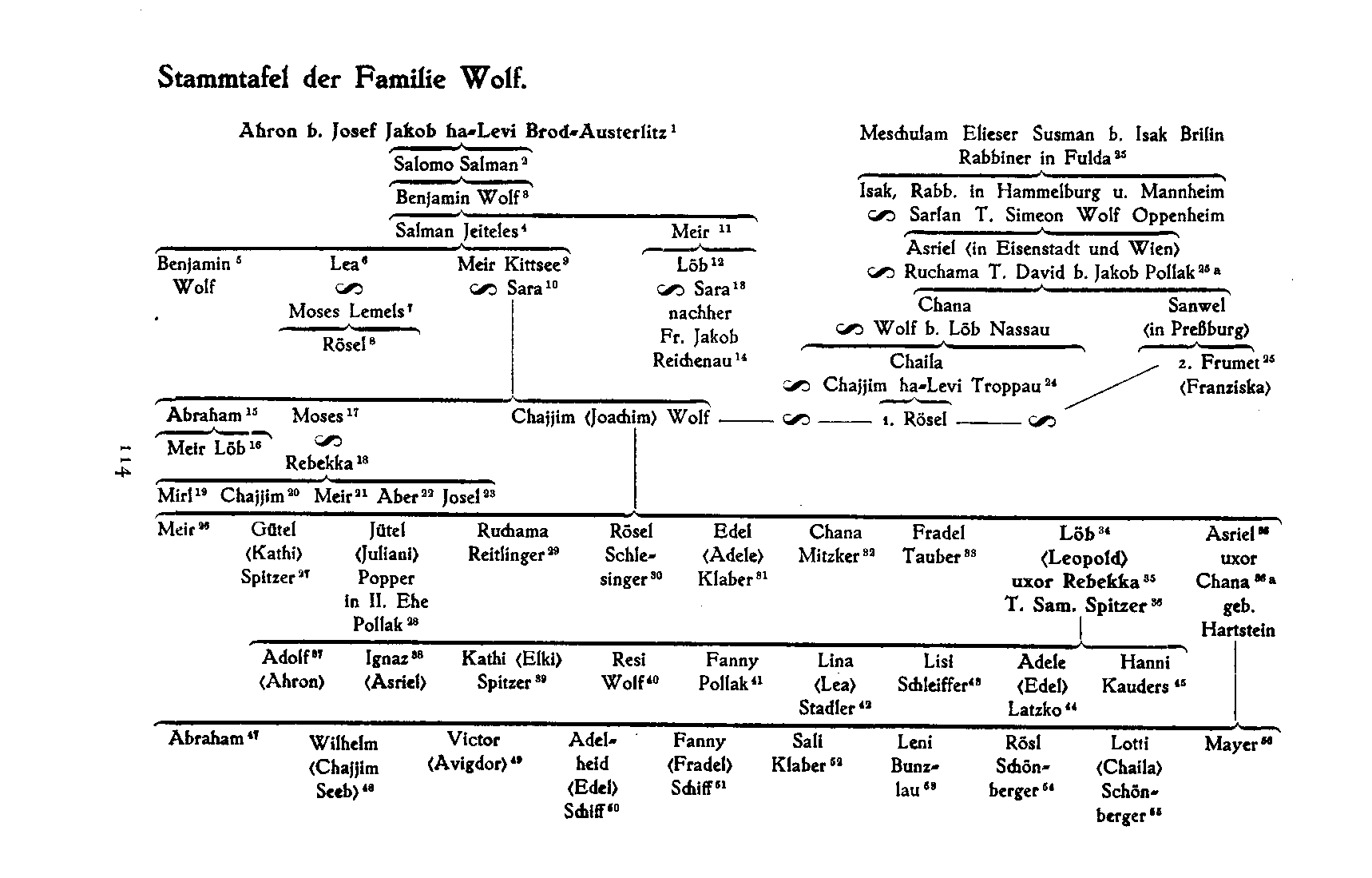
It is not generally known that Sandór Wolf - his Eisenstadt house is now a regional museum and houses one of Haydn's gorgeous organs - was the grandfather of the world-renowned potter Lucie Rie. See photos in my FLICKR site here.
Sándor Wolf (Eisenstadt Nov. 21, 1871 - Haifa Jan. 2, 1946) was a wine wholesaler, art collector and researcher. He was also a scholar/archaeologist and collaborated with Bernhard Wachstein - click here for more information - in a momentous tome on the transcriptions of the Eisenstadt cemetery: “Die Grabinschriften des alten Judenfriedhofes in Eisenstadt mit einer Studie: Die Entwicklung des jüdischen Grabsteines und die Denkmäler des Eisenstädter Friedhofes von S. Wolf (Eisenstädter Forschungen 1).
Wolf was particularly interested in ancient settlements and artefacts of the Burgenland and there is evidence that Jews had arrived in this area with the Roman Legions, well over 1,000 years before the first Jewish community settled in Eisenstadt in the 1370s.
The Esterházys took the Jewish community under their protection in 1622 when they inherited the area estates. The Jewish population increased and the fame of tiny Eisenstadt as a centre of Jewish learning and scholarship spread throughout the world.
In 2008, a gold scroll was discovered in the Burgenland, as the earliest evidence of Jewish inhabitants in the region, now part of Austria; the amulet was inscribed with a Jewish prayer and found in a Roman child’s grave dating back to the 3rd century at a burial ground in Halbturn. Read about these here.
There is a WOLF GOMPERZ RIE family archive here with many pictures.
Lucie Gomperz was the youngest child of three and the only daughter of Dr. Benjamin and Gisela Gomperz. Dr. Gomperz was a successful ear, nose and throat specialist in Vienna. Gisela Gomperz née Wolf was born into the wealthy Wolf family. The Gomperz children, who lived in Vienna, spent a lot of time at the Wolf estate in Eisenstadt.
Here is an excellent German-language article with photographs about this fascinating family, and a family tree here.
Burials in Eisenstadt cemetery illustrated here took place from 1679-1874. There is a later Jewish cemetery I did not visit on this trip.
The Israelitische Kultusgemeinde {IKG - Vienna} cemetery database lists about 1,200 burials in Eisenstadt cemetery and the names - many patronymics- are very evocative. Here are four entries:
Fr. Hindel T. Abraham ha-Levi Spitz (Fr. Elia Lichtenstadt) 5th row 223
Frumet T. Elia Zebi aus Trebitsch, Fr. Pinchas Ahron Halberstadt 07/30/1802 5th row 464
Gumpel Emmerich, Fr. Meir Preßburg (ben Mich. Lazar ben Simon Michl) Golda T. 02/27/1794 5th row 264
Jehuda Löb ben Ascher Anschel Jafe-Margulies (Schlesinger) 5th row 19
Eisenstadt was called *Asch* in Hebrew because the two Hebrew letters A(lef) and S(chin) are derived from E(A)eisenStadt. Thus, Asch may imply the family name Eisenstadt or an origin from Eisenstadt viz: Meir b. Isaac Eisenstadt [MaHaRaM A"Sh].
Read about the Eisenstadt Jewish community in these three short articles:
Jewish Encyclopedia, Beth Hatefutzot and the Jewish Virtual Library
Finally, look at my FLICKR pictures here.
Tuesday, December 30, 2008
Spain: Toledo cemetery work halted
Both Tracing the Tribe and this blog reported on the medieval Jewish cemetery discovered during a construction project in Toledo, Spain.
According to JTA, the Spanish government ordered a freeze on the school building project on December 19, following meetings at the Spanish Foreign Ministry with representatives of the Federation of Jewish Communities in Spain, the Conference of Spanish Rabbis, the Conference of European Rabbis and the Committee for the Preservation of Jewish Cemeteries in Europe (CPJCE).
The freeze will last until January 15, 2009, although a scheduled January 12 meeting in Toledo will see Jewish organizations requesting that the freeze be extended until the matter is resolved.
A rabbinic board is consulting with international rabbinic courts to determine what can be done according to Jewish law. There are many intact graves inside the 13th century cemetery.
According to JTA, the Spanish government ordered a freeze on the school building project on December 19, following meetings at the Spanish Foreign Ministry with representatives of the Federation of Jewish Communities in Spain, the Conference of Spanish Rabbis, the Conference of European Rabbis and the Committee for the Preservation of Jewish Cemeteries in Europe (CPJCE).
More than 100 graves have been exhumed from the building site, an expansion of a nearby state school, according to Rabbi Abraham Ginsburg, executive director of the Committee for the Preservation of Jewish Cemeteries in Europe.
Toledo regional authorities are currently storing more than 100 skeletons in separate boxes, Ginsburg told JTA Thursday.
‘At present our main aim is to ensure that no further desecration is taking place and we are committed by Jewish law and tradition to ensure that those graves are being preserved in their sanctified and dignified manner in perpetuity,’ Ginsburg said.
The freeze will last until January 15, 2009, although a scheduled January 12 meeting in Toledo will see Jewish organizations requesting that the freeze be extended until the matter is resolved.
A rabbinic board is consulting with international rabbinic courts to determine what can be done according to Jewish law. There are many intact graves inside the 13th century cemetery.
Monday, December 29, 2008
Georgia: Savannah Jewish burial marker
The Historical Marker Database provides images of markers concerning the Jewish cemetery in Savannah, Georgia.
This marker was erected by the Georgia Historical Marker group, and the inscription reads:
See the link above for other markers and more information.
This marker was erected by the Georgia Historical Marker group, and the inscription reads:
Established by Mordecai Sheftall on August 2, 1773 from lands granted him in 1762 by King George III as a parcel of land that "shall be, and "forever remain, to and for the use and purpose of a Place of Burial for all persons whatever professing the Jewish Religion.
During the ill fated attempt of the French forces under Admiral Charles Henri, Comte d'Estaing, and the American forces under General Benjamin Lincoln, to recapture Savannah from the British, General Lincoln's Orders of the Day of October 8, 1779 stated that "The second place of rallying, or the first if the redoubt should not be carried, will be at the Jew's burying ground, where the reserve will be placed."
According to the account of Captain Antoine-Francoise Terance O'Conner, a military engineer serving with the French forces, on October 9, 1779, shortly after 4:00 A. M. "The reserve corps, commanded by M. le Vicomte de Noailles, advanced as far as an old Jewish cemetery, and we placed on its right and a little to the rear the four 4-pounders."
See the link above for other markers and more information.
Tuesday, December 23, 2008
Massachusetts: Jewish Cemetery Association
The Jewish Cemetery Association of Massachusetts now has a blog, begun in November. The site does not appear to be very active (10 postings in November, only 1 in December), but there are some interesting items there.
Click on the above link to read the postings. Click here for the JCAM site with news and announcements pertaining to the state's Jewish cemeteries. Learn about the JCAM's newest edition of "History & Guide: Massachusetts Jewish Cemeteries" as part of their 25th anniversary commemoration. It includes maps and directions to all 209 state Jewish cemeteries and history from 1844.
Are your ancestors resting at a Massachusetts Jewish cemetery? What does that cemetery mean to you? What are some of your memories about those resting there?
This category is intended to introduce you an important contribution related to our Jewish presence in Massachusetts—Jewish cemeteries. Many people are not aware of the significant role that Jewish cemeteries played and still plays in the formation of our vibrant Jewish communities in Massachusetts today.
For instance, did you know that the first Jewish cemetery in Massachusetts was established in 1844 in East Boston (Ohabei Shalom Cemetery, see above picture). Did you also know that prior to 1844 Jews were not allowed to be buried in Massachusetts?
Click on the above link to read the postings. Click here for the JCAM site with news and announcements pertaining to the state's Jewish cemeteries. Learn about the JCAM's newest edition of "History & Guide: Massachusetts Jewish Cemeteries" as part of their 25th anniversary commemoration. It includes maps and directions to all 209 state Jewish cemeteries and history from 1844.
Sarajevo's Jewish cemetery
 Sarajevo Jewish Cemetery, c1900
Sarajevo's long and important Jewish history is addressed in this article in the online Balkan Insight.
The story concerns the war in Bosnia and the Jewish community, but for this blog, the important focus is the information on the famous Sarajevo cemetery.
The author, Denis Dzidic, quotes USHMM researcher Aleksandra Cholewa who is working on a project in Bosnia documenting crimes against Jews during WWII. The Commission for Preservation of National Monuments in Bosnia and Herzegovina reported that five of the eight most significant Jewish monuments were damaged during the three-year seige, 1992-1995.
The Sarajevo cemetery on Mount Trebevic in Kovacici is a very famous Sephardic burial site, and was established in 1630 when the land was rented by Rabbi Samuel Baruch. His gravestone existed until the fighting in the 1990s. Unfortunately, the site took direct hits during the fighting. The unusually shaped tombstones (see below) are inscribed in Hebrew and Ladino (Judeo-Spanish).
The story concerns the war in Bosnia and the Jewish community, but for this blog, the important focus is the information on the famous Sarajevo cemetery.
The author, Denis Dzidic, quotes USHMM researcher Aleksandra Cholewa who is working on a project in Bosnia documenting crimes against Jews during WWII. The Commission for Preservation of National Monuments in Bosnia and Herzegovina reported that five of the eight most significant Jewish monuments were damaged during the three-year seige, 1992-1995.
The Sarajevo cemetery on Mount Trebevic in Kovacici is a very famous Sephardic burial site, and was established in 1630 when the land was rented by Rabbi Samuel Baruch. His gravestone existed until the fighting in the 1990s. Unfortunately, the site took direct hits during the fighting. The unusually shaped tombstones (see below) are inscribed in Hebrew and Ladino (Judeo-Spanish).

The chief glory of the cemetery was the gravestones, erected in a style found nowhere else expect Spain – the land from which many Bosnian Jews's ancestors came, after being expelled by the ultra-Catholic monarchs, Ferdinand and Isabella.
The Commission for Preservation of National Monuments in Bosnia estimates that “about 95 per cent of the stones” were damaged in the war. The Cemetery was also mined, and was not cleared until 1998.
Bosnia and Herzegovina was home to some 14,000 Jews before WWII and most of them lived in Sarajevo. Only 4,000 survived and half of them moved to Israel.
Today, Sarajevo has about 800 Jewish residents, with smaller numbers in Tuzla, Mostar and Zenica. In the Serbian republic (Republika Srpska), there are some 200 Jews, half in Doboj, the rest in Banja Luka.
Since November 2005, Cholewa has collected the oral histories of some 200 Jews in former Yugoslavia. The article also interviewed former residents and detailed their history and escape from the city, how international organizations organized convoys and where the Jewish refugees went.
Here's the link to more detailed information about the cemetery from the 2003 report made by the International Survey of Jewish Monuments.
For more information on former Yugoslav Jewish cemeteries, see JewishGen's International Cemetery Project here. Click here for more on the Jewish history of Sarajevo.
The history of the Jews in Sarajevo can be traced back over 400 years ago when the first Jews arrived in Sarajevo as early as 1541 via Salonika. They were mostly artisans, merchants, pharmacists, and doctors. They built their own quarter, dubbed El Cortijo (the courtyard), in 1577 with permission from the pasha Siavush. The community built a synagogue in El Cortijo in 1580 with the help of a Turkish benefactor, in a building called Velika Avlija. By the end of the 16th century, the building where Velika Avlija stood became known as old Jewish Cathedral, Sarajevo’s first synagogue.
Click here for an excellent newsletter article and photos from Hebrew University's Center of Jewish Art's newsletter on former Yugoslav Jewish cemeteries and synagogues titled "Bosnia/Herzegovina and Croatia: Documenting Jewish Art and Architecture."
Subscribe to:
Posts (Atom)


 Posts
Posts