The Stockholm (Sweden) News Online in English reported that on the morning of January 13, Molotov cocktails were thrown inside and outside the funeral chapel at the old Jewish cemetery in the city of Malmö, south Sweden.
No one was injured and the emergency service quickly got the fire under control. Police have made some findings at the scene.
There are more details at The Local (Swedish News in English).
Saturday, January 17, 2009


Monday, January 12, 2009
Virginia: Confederate Soldiers Jewish cemetery
JewishHistory.com has an entire section devoted to the Cemetery for Hebrew Confederate Soldiers.
According to the site, the Shockoe Hill cemetery in Richmond, Virginia - maintained by Congregation Beth Ahabah - is the only Jewish military cemetery in the world outside the state of Israel.
A plaque erected in 1866 by the Hebrew Ladies Memorial Association of Richmond, holds the names of those Jewish soldiers who died during the Civil War.

M. Levy, Mississippi, killed May 31, 1862.
J. Rosenberg, Ga.
Henry Adler, 46th Va.
E.J. Sampson, 4th Texas, killed June 27th, 1862.
G. Wolfe, N.C.I. Hessberg, Caroline co.
Unknown soldier
Henry Gersberg, Salem, Va., killed June 2, 1864.
T. Foltz, 16th Miss.
I. Cohen, Hampton (S.C.) Legion.
Sam Bear, Ga.
S. Bachrach, Lynchburg, Va.
Jonathan Sheuer, La.
J. Frank, Ga.
Henry Cohen, S.C. killed June 29, 1864.
Capt. Jacob A. Cohen, Co. A, 10th La., killed at 2nd Manassas, August 30, 1862, age, 33 years.
M. Aaron, N.C.A. Lehman, S.C.
Julius Zark, 7th Louisiana.
A. Heyman, Georgia.
Lieut. W.M. Wolf, Hagood's S.C. Brigade, died May 9, 1864.
Lieut. L.S. Lipman, 5th Louisiana, died May 9, 1863.
Erected by his brothers to the memory of Isaac Seldner, of the 6th Virg. Inf. Reg., born December 23, 1837, killed at the battle of Chancellorsville, Va., May 3rd, 1863. None knew him but to love him.
S. Weiss, Ga.
H. Jacobs, S.C.E.B. Miller, died April 6, 1864.
Corpl. G. Eiseman, 12th Miss.
M. Bachrach, Lynchburg, Va.
S. Oury, 16th Miss.; died June 10, 1861.
A. Robinson, 15th Ga., died Jan. 26, 1863.
There are also soldiers killed in battle and buried elsewhere:
Gustavus Kann, 16th Mississippi;
Henry Smith, Richmond, Otey Battery;
Marx Myers, Richmond Grays;
Isaac J. Levy, Richmond Blues
Captain M. Marcus, 15th Georgia, killed October 13, 1864.
The site has many very interesting resources - take some time to look around.
According to the site, the Shockoe Hill cemetery in Richmond, Virginia - maintained by Congregation Beth Ahabah - is the only Jewish military cemetery in the world outside the state of Israel.
A plaque erected in 1866 by the Hebrew Ladies Memorial Association of Richmond, holds the names of those Jewish soldiers who died during the Civil War.

M. Levy, Mississippi, killed May 31, 1862.
J. Rosenberg, Ga.
Henry Adler, 46th Va.
E.J. Sampson, 4th Texas, killed June 27th, 1862.
G. Wolfe, N.C.I. Hessberg, Caroline co.
Unknown soldier
Henry Gersberg, Salem, Va., killed June 2, 1864.
T. Foltz, 16th Miss.
I. Cohen, Hampton (S.C.) Legion.
Sam Bear, Ga.
S. Bachrach, Lynchburg, Va.
Jonathan Sheuer, La.
J. Frank, Ga.
Henry Cohen, S.C. killed June 29, 1864.
Capt. Jacob A. Cohen, Co. A, 10th La., killed at 2nd Manassas, August 30, 1862, age, 33 years.
M. Aaron, N.C.A. Lehman, S.C.
Julius Zark, 7th Louisiana.
A. Heyman, Georgia.
Lieut. W.M. Wolf, Hagood's S.C. Brigade, died May 9, 1864.
Lieut. L.S. Lipman, 5th Louisiana, died May 9, 1863.
Erected by his brothers to the memory of Isaac Seldner, of the 6th Virg. Inf. Reg., born December 23, 1837, killed at the battle of Chancellorsville, Va., May 3rd, 1863. None knew him but to love him.
S. Weiss, Ga.
H. Jacobs, S.C.E.B. Miller, died April 6, 1864.
Corpl. G. Eiseman, 12th Miss.
M. Bachrach, Lynchburg, Va.
S. Oury, 16th Miss.; died June 10, 1861.
A. Robinson, 15th Ga., died Jan. 26, 1863.
There are also soldiers killed in battle and buried elsewhere:
Gustavus Kann, 16th Mississippi;
Henry Smith, Richmond, Otey Battery;
Marx Myers, Richmond Grays;
Isaac J. Levy, Richmond Blues
Captain M. Marcus, 15th Georgia, killed October 13, 1864.
The site has many very interesting resources - take some time to look around.
Ukraine: A photo essay
Here's photographer Trix Rosen's essay - and wonderful photographs - on her August 2008 trip to Ukraine.
I learned about Rosen in a posting by Ruth Ellen Gruber, with a link to Gruber's own photos of Ukraine. Rosen used Gruber's book, Jewish Heritage Travel: A Guide to Eastern Europe, to organize her trip.
Rosen writes:
She describes the tombstones and their carvings of animals and symbols.
I learned about Rosen in a posting by Ruth Ellen Gruber, with a link to Gruber's own photos of Ukraine. Rosen used Gruber's book, Jewish Heritage Travel: A Guide to Eastern Europe, to organize her trip.
Rosen writes:
She offers evocative photograph, arranged in albums, of the cemeteries located in Chernivtsi, Sadhora, Shahhorod, Kremenets, Sataniv and Medzhybizh.For me, a first-generation American, an artist, a photojournalist, and a historical preservation photographer, they have become a portal to rediscovering my own Jewish heritage.
Bet Hayyim - The House of Life
I could see hundreds of stones jutting out of the hills in all directions, leaning this way and that like silent figures pushing out toward the sun. In the distance, the worn grey, beige and brown graves were stark monuments, reminders of the people who had lived out their lives in this place, and died.
The cemeteries seemed to be swallowed up by nettles, wildflowers and hills of exuberant goldenrod. Where the ground had shifted, the displaced stones appeared as monoliths from some ancient civilization, left by time to lean against one another.
In August 2008 I travelled to the Ukraine for the first time, to meet two of my friends and to visit Odessa, the birthplace of my father. My two-week visit became an exploration into the history of the once vast community of Eastern European Jews and the relics they had left behind.
This odyssey started in Kiev at the ravine in Babi Yar, and took me to the tombs of Rabbi Nachman in Uman and the Ba’al Shem Tov in Medzhybizh, two historic Hasidic pilgrimage sites associated with the Kabbalah. I crisscrossed the heartland, over 2000 kilometers, to visit cities, towns, and shtetls, and to photograph the carved tombstones in cemeteries dating back to the 1400’s. ...
She describes the tombstones and their carvings of animals and symbols.
Some epitaphs were intricately carved, the stones decorated in an elaborate Jewish script covering the entire surface; others held only the most minimal outline of the Star of David. Massive, six-foot-high sculptures of tree trunks with their branches cut off towered over the simpler stones. Some retained a residue of ochre and blue paint, (perhaps the final touch of the engravers and stonecutters), while others were covered only in lichen and moss. ...The cemeteries - called Bet Hayyim (Hebrew for House of Life) - survived pogroms and Nazi murders of Jews who lived nearby. Read the complete essay at the link above.
Sunday, January 11, 2009
Cleveland: Outside of the box
Arlene Fine of the Cleveland Jewish News is doing a series on women with unusual occupations. This Friday, it was the turn of Karen Gutner of Classic Monuments, who helps families select and personalize headstones.
Gutner says that in the case of a woman who has married more than once, the choice of wording can be a problem when everyone gets into the act (children, stepchildren, surviving husband/s or parent/s) as to what names will appear on the stone.“Sometimes I feel more like a psychologist than a salesperson,” says the Lyndhurst resident. “I get a lot of white-knuckle flyers walking in the door. I understand that anything relating to death can be scary.”
After they get over their uneasiness, most of Gutner’s clients have sticker shock. The average headstone can run anywhere from $500 to $5,000, and that does not include the cemetery fee for the cement installation to hold the headstone in place.
When some clients learn the cost of the stone is not included in the funeral expenses paid months before, “they are not happy,” Gutner admits. “I try to soften the blow by suggesting locally quarried rather than imported granite.”
But that is not the only issue people must consider. Every cemetery or cemetery association has rules as to the height and width, color and shape of a tombstone. Gutner keeps a handbook listing all requirements and restrictions as a verifiable reference.
“Some family members come in with requests for grandly designed monuments,” she says. “They are astonished and often angry when I tell them a simple granite marker is all that is permitted on that particular plot of land.”
After a headstone is selected, the wording can be the next hurdle.
“Sometimes I have to act as a referee as the gansa mishpochah (whole family) have heated arguments at my desk over the tombstone inscription.” In the end, she adds, whoever is paying for the tombstone or monument usually wins.”The article ends with Gutner's pleas for individuals to visit a memorial business and pre-pay for the tombstone when prepaying for a funeral.
Wednesday, January 7, 2009
Poland: Jozefow Bilgorajski cemetery cleaned

After the clean-up, Jozefow Bilgorajski Jewish Cemetery, Poland (FODZ)
Ruth Ellen Gruber writes in Jewish Heritage Travel about the clean-up project in the Jozefow Bilgorajski Jewish cemetery in eastern Poland.
The project was co-financed by the Foundation for the Preservation of Jewish Heritage in Poland (FODZ) and the Polish Ministry of Culture and National Heritage.
Ruth has posted her own photographs, and FODZ has also created an online photo gallery of the results.
The project was co-financed by the Foundation for the Preservation of Jewish Heritage in Poland (FODZ) and the Polish Ministry of Culture and National Heritage.
Ruth has posted her own photographs, and FODZ has also created an online photo gallery of the results.
Jews settled in Jozefow in the 18th century, and by 1921 nearly 80 percent of the local population was Jewish. A very nice baroque-style synagogue, built in the late 18th or early 19th century, now serves as the town library.
The oldest tombstones in the cemetery date from the 1760s. I visited there in the summer of 2006, when I was doing the updates for Jewish Heritage Travel. The local librarian was very helpful, giving me explicit instructions how to find the cemetery, located near quarries on a hill just outside town. Access is via a dirt road off Kamienna street.
Parts of the cemetery were - sort of - clear, or at least fairly accessible, even in "high weed" season. But much of the cemetery was jungle.... Here are some photos to compare how it was, with the pictures on the FODZ site showing the area after clean-up.
Do visit Ruth's blog to see her photographs. Follow the links for more information.
Sunday, January 4, 2009
Austria: A visit to Eisenstadt cemetery


The tiny town of Eisenstadt means different things to different people. There can be strange juxtapositions in the study of Jewish cemeteries and genealogy. Here you will find at least four: the composer Joseph Haydn; the Esterházy family, a world-renowned potter and an ancient Jewish community in Eisenstadt in the Burgenland (Austria).
Joseph Haydn was born in Rohrau (Lower Austria) on March 31, 1732, and died in Vienna on May 31, 1809. I am such a Haydn fan that I visited his birthplace a few years ago, at the exact day and moment of his birth - I was the only visitor!
Haydn was often a reluctant resident of Eisenstadt as he and his musicians had to spend the summer there; Haydn was employed to compose “to order” and play almost daily to entertain the Esterházy court and its many visitors.
It was the same Count Nikolaus Esterházy who was the Schutzherr of the Jews of Eisenstadt, who lived within the castle estate. After Vienna, Haydn found Eisenstadt very tedious as it was so small and restrictive. When Count Nikolaus died, the composer went to London and was in seventh heaven.
Haydn was awarded the first-ever Honorary Doctor of Music at Oxford and I too have an Oxford degree and have trodden in his footsteps in that historic University town. If you have never listened to Haydn’s Creation - based on the Old Testament account of the seven days of creation - and his secular oratorio, The Seasons, you are in for a treat in 2009, the 200th anniversary of Haydn’s death.
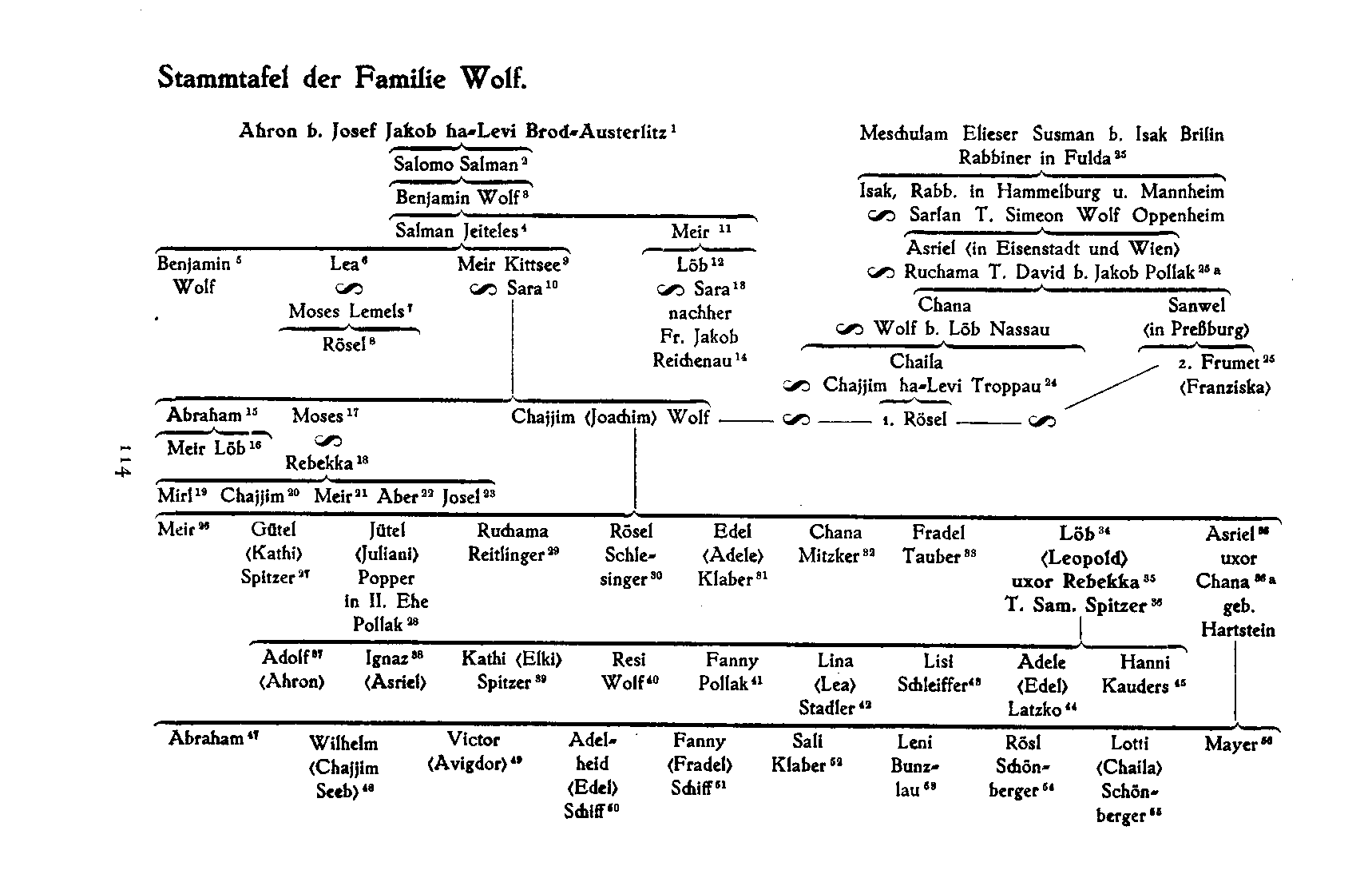
It is not generally known that Sandór Wolf - his Eisenstadt house is now a regional museum and houses one of Haydn's gorgeous organs - was the grandfather of the world-renowned potter Lucie Rie. See photos in my FLICKR site here.
Sándor Wolf (Eisenstadt Nov. 21, 1871 - Haifa Jan. 2, 1946) was a wine wholesaler, art collector and researcher. He was also a scholar/archaeologist and collaborated with Bernhard Wachstein - click here for more information - in a momentous tome on the transcriptions of the Eisenstadt cemetery: “Die Grabinschriften des alten Judenfriedhofes in Eisenstadt mit einer Studie: Die Entwicklung des jüdischen Grabsteines und die Denkmäler des Eisenstädter Friedhofes von S. Wolf (Eisenstädter Forschungen 1).
Wolf was particularly interested in ancient settlements and artefacts of the Burgenland and there is evidence that Jews had arrived in this area with the Roman Legions, well over 1,000 years before the first Jewish community settled in Eisenstadt in the 1370s.
The Esterházys took the Jewish community under their protection in 1622 when they inherited the area estates. The Jewish population increased and the fame of tiny Eisenstadt as a centre of Jewish learning and scholarship spread throughout the world.
In 2008, a gold scroll was discovered in the Burgenland, as the earliest evidence of Jewish inhabitants in the region, now part of Austria; the amulet was inscribed with a Jewish prayer and found in a Roman child’s grave dating back to the 3rd century at a burial ground in Halbturn. Read about these here.
There is a WOLF GOMPERZ RIE family archive here with many pictures.
Lucie Gomperz was the youngest child of three and the only daughter of Dr. Benjamin and Gisela Gomperz. Dr. Gomperz was a successful ear, nose and throat specialist in Vienna. Gisela Gomperz née Wolf was born into the wealthy Wolf family. The Gomperz children, who lived in Vienna, spent a lot of time at the Wolf estate in Eisenstadt.
Here is an excellent German-language article with photographs about this fascinating family, and a family tree here.
Burials in Eisenstadt cemetery illustrated here took place from 1679-1874. There is a later Jewish cemetery I did not visit on this trip.
The Israelitische Kultusgemeinde {IKG - Vienna} cemetery database lists about 1,200 burials in Eisenstadt cemetery and the names - many patronymics- are very evocative. Here are four entries:
Fr. Hindel T. Abraham ha-Levi Spitz (Fr. Elia Lichtenstadt) 5th row 223
Frumet T. Elia Zebi aus Trebitsch, Fr. Pinchas Ahron Halberstadt 07/30/1802 5th row 464
Gumpel Emmerich, Fr. Meir Preßburg (ben Mich. Lazar ben Simon Michl) Golda T. 02/27/1794 5th row 264
Jehuda Löb ben Ascher Anschel Jafe-Margulies (Schlesinger) 5th row 19
Eisenstadt was called *Asch* in Hebrew because the two Hebrew letters A(lef) and S(chin) are derived from E(A)eisenStadt. Thus, Asch may imply the family name Eisenstadt or an origin from Eisenstadt viz: Meir b. Isaac Eisenstadt [MaHaRaM A"Sh].
Read about the Eisenstadt Jewish community in these three short articles:
Jewish Encyclopedia, Beth Hatefutzot and the Jewish Virtual Library
Finally, look at my FLICKR pictures here.
Saturday, January 3, 2009
Colorado: Tuberculosis victims' graves, records
International Jewish Graveyard Rabbit is happy to introduce new contributor Ellen Shindelman Kowitt. She is the webmaster for the Jewish Genealogical Society of Colorado. A former IAJGS board member and past president of JGS Greater Washington, she lectures and writes about Jewish genealogy.
Jews arrived in Colorado with the Gold Rush in 1859. The oldest Jewish burials in Denver were conducted by the pioneer organization, the Hebrew Burial and Prayer Society (later known as the Hebrew Cemetery Association) from 1860 to 1910 and were interred at the Denver Pioneer Cemetery “Old Jewish Section” located east of Cheesman Park on Capitol Hill.
Most Jewish remains and gravestones there were moved to the nonsectarian Riverside Cemetery and to the Jewish Fairmount, Golden Hill and Rose Hill Cemeteries in the early 1900s due to urban development.
 At the time, common treatment of tuberculosis called for "freezing the disease out of them with access to fresh Rocky Mountain Air," and patients lived in these unheated buildings.
In Denver cemeteries, many Jewish burials circa 1899-1954 were of those who travelled to two Colorado Jewish sanitariums for the treatment of tuberculosis. National Jewish Hospital opened in 1899, and catered largely to Jews with a less severe case of tuberculosis who were of German background and more assimilated. The Jewish Consumptives Relief Society (JCRS) served those with advanced stages of the disease and who were recent Russian immigrants. JCRS was a kosher facility with an onsite synagogue, and the patients were often observant.
Here are two stones and a donation plaque for Ernest Gluck:

The English name reads Ernest Gluck, whose Hebrew name and father's name are Aharon Yeshai ben Menachem Mendl.

This stone above, with the same details, begins with a note about the Shoah (Holocaust). This second stone might have been erected by his family, particularly since it mentions erasing the Nazis - unrelated to a Colorado tubercular’s grave - but perhaps representative of stones in that generation commemorating others who died in the Shoah elsewhere.

This plaque was apparently constructed by his friends at JCRS.
Members of the Jewish Genealogical Society of Colorado assisted the University of Denver Judaic Studies Division with the creation of an online JCRS patient surname index. This project was awarded the IAJGS Malcolm Stern Grant in 2003. Copies of JCRS patient applications (click here to see a sample) can be requested and often include birthplace abroad, landsmanshaften affiliation, names and ages of children, nearest of kin and burial location at Denver cemeteries.
Rose Hill Cemetery in Commerce City, Golden Hill Cemetery in Lakewood and Mount Nebo Cemetery in Aurora specifically included tuberculosis patient burials. A significant number were buried by benevolent groups as indigent and in unmarked pauper graves.
Regardless of whether a gravestone ever existed or has survived, all Colorado Jewish burial data has been gathered from local sources, indexed, entered into the JewishGen Online Worldwide Burial Registry and can be searched by the name of the deceased, cemetery or location. Gravestone inscriptions have been translated into English from Hebrew, Yiddish and Russian.
Following are the four largest Jewish cemeteries in the Denver metro area:
Rose Hill Cemetery: Burials 1892-present; includes tuberculosis patients from JCRS.
Mount Nebo Cemetery: Burials 1904-present; includes tuberculosis patients from JCRS.
Golden Hill Cemetery: Burials 1908-present; includes tuberculosis patients from JCRS.
Emanuel at Fairmount Cemetery: Burials 1911-present.
Subscribe to:
Posts (Atom)


 Posts
Posts